
In this edition of our Iconic Packs series we examine the history of McDonald’s packaging, from the launch of the Happy Meal in 1979 to its changes of material from paper to plastic and back again – and its recent incorporation of reusable packaging and recycled materials. We look at how the company’s designs have evolved over the years and what design and material changes have been made to improve sustainability.
In a Medium article exploring McDonald’s packaging design and its impact on the fast-food and packaging industries, Logan Fiorito-Zendejas states that the brand was built off of quick service, meaning the typical tray, plate and utensils had to go. As a result, paper products ‘took the industry by storm’, seen as cheap and quick packaging allowing the user to eat their food anywhere.
“Making things convenient and fulfilling has been the main goal of McDonalds, whether that be a sauce holder built into the box or the shape of the fry container making the fries look fuller.”
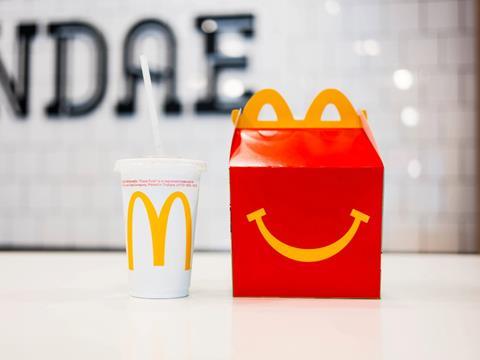
Fiorito-Zendejas adds that the Happy Meal design impacted the fast-food industry and culture, as the advent of kids’ meals for fast food made the chain instantly recognizable to all ages. The box has a house-shaped design and traditionally features toys alongside the food inside, although originally there was a more ‘cereal box appeal’ with jokes and games on the side.
In the 2000s, the red and yellow colour scheme of the packaging with the well-known golden arches became more pronounced, intended to trigger dopamine sensors in the brain as it was found to ‘increase appetite and happiness’ when seeing the McDonalds colours. There was also a shift away from plastics for the burger boxes as the idea of sustainability became more popularized.
Fiorito-Zendejas says on box messaging also started to promote healthy eating by placing images and messages of fresh ingredients being used on the boxes to encourage people to buy more, as the company positioned its packaging to feel lighter and healthier.
As of 2025, the chain’s packaging ‘embraced millennial beige modernism’ to reflect the ideals of consumers, beginning to dissociate with an unhealthy image by branding itself with earthy tones again and introducing more paper packaging, circling back to an earlier era.
Reducing waste
An article from Tasting Table outlines some of McDonald’s efforts to reduce packaging waste over the years. In the 1980s, burgers came in Styrofoam boxes and several of the 14 vintage McDonald’s Happy Meal boxes featured large, hard-plastic food boxes shaped like boats and train cars.
Article author Autumn Swiers states that ‘while the packaging for 1982’s McDonaldland Express and 1983’s Ship Shape promotions may have been collectible, many of those plastic meal containers likely ended up in landfills’. The 1990s saw Styrofoam boxes and drink cups give way to more ‘eco-friendly’ materials.
By the 2000s, Swiers says the shift away from gimmicky packaging was ‘immediately impactful’, adding that according to McDonald’s website, the first initiative ‘eliminated more than 300 million pounds of packaging’ and ‘reduced waste by 30 percent’.
Reusable packaging and recycled materials
According to the company website, McDonald’s has recently developed a reusable packaging portfolio made of plastic, to respond to reusable packaging requirements as they arise. It adds that ceramics, metals, glass, and non-food-safe plastics were rejected due to safety concerns and ‘the impracticality of serving millions of customers with heavier, brittle materials across both dine-in and take-out’.
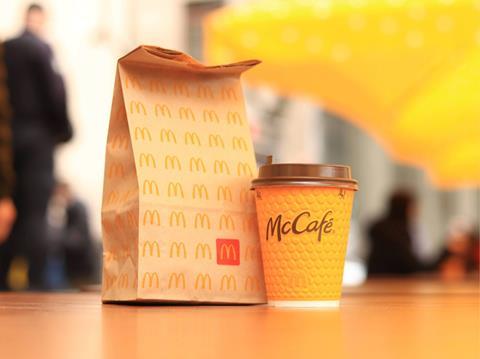
Recycled materials have been introduced in some hot beverage cups, cup sleeves, cartons, fry boxes, plastic beverage and dessert cups and select plastic lids, depending on location. Aiming to transition away from virgin fossil fuel-based plastics, the company has reduced small plastic primary guest packaging that is ‘hard to recycle and unnecessary for safety or functionality’, such as straws, plastic bags and cutlery.
McDonald’s states it is also exploring ways to help increase plastics recyclability, demand for recycled plastics and promote plastic alternatives such as moulded fibre, starch-based cups and mineral coatings for fibre.
How has the Happy Meal packaging evolved over time?
Since its introduction in the late 1970s, the now well-known children’s Happy Meal packaging has gone through many design and material changes, from the box itself to the toys inside.
Business Insider highlights that McDonald’s first revealed its Happy Meal in the US in 1979, after McDonald’s employee Yolanda Fernández de Cofiño created ‘Menu Ronald’, which combined a hamburger, small fries, and a small sundae specifically for young customers in Guatemala. The company’s advertising executive, Bob Bernstein, brought the idea to the US and replaced ice cream with toys.
According to an article by the Independent, McDonald’s pledged in March 2020 that it would be removing hard, plastic toys from Happy Meals in the UK after two schoolgirls started a petition to have them taken out.
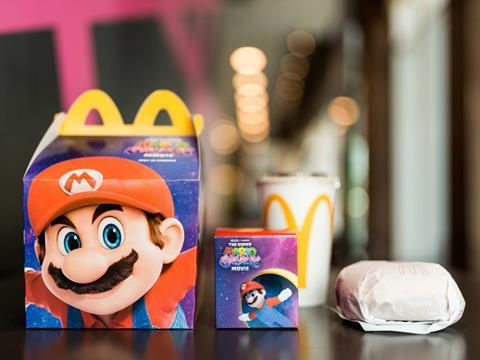
More recently, the company announced that by the end of 2025 ‘every toy, in every Happy Meal sold around the world, will be more sustainable’. Examples of this include movie characters that were previously plastic figurines re-appearing as 3D figures that can be built and decorated, and in other instances such as like board games, virgin fossil fuel based plastic game pieces may be swapped out in favour of accessories made from ‘certified plant-derived or recycled materials’.
McDonald’s says this transition is already underway in countries including the UK and Ireland, and complete in France. Beyond the toys, the business has also explored recycling old toys into new restaurant trays and replacing plastic wrappers on the toys with new plant-based and premium certified fibre packaging.
If you liked this story, you might also enjoy:
The ultimate guide to packaging innovation in 2026
Packaging and Packaging Waste Regulation: what to know in 2026
Everything you need to know about global packaging sustainability regulation
Strategic learnings from the Sustainable Packaging Summit







No comments yet