
‘World’s first’ resealable fibre tray developed for proteins, produce and more
Cirkla, Belmark and Ossid have unveiled the ‘world’s first’ resealable fibre tray, intended as a sustainability-minded, scalable, and
Cirkla, Belmark and Ossid have unveiled the ‘world’s first’ resealable fibre tray, intended as a sustainability-minded, scalable, and

In its latest paper, The Consumer Goods Forum has set out packaging design guidelines to avoid pollution, increase recycling rates,
Smurfit Westrock, AB InBev and JKR have designed a fibre-based packaging concept that carries one bottle of alcohol-free

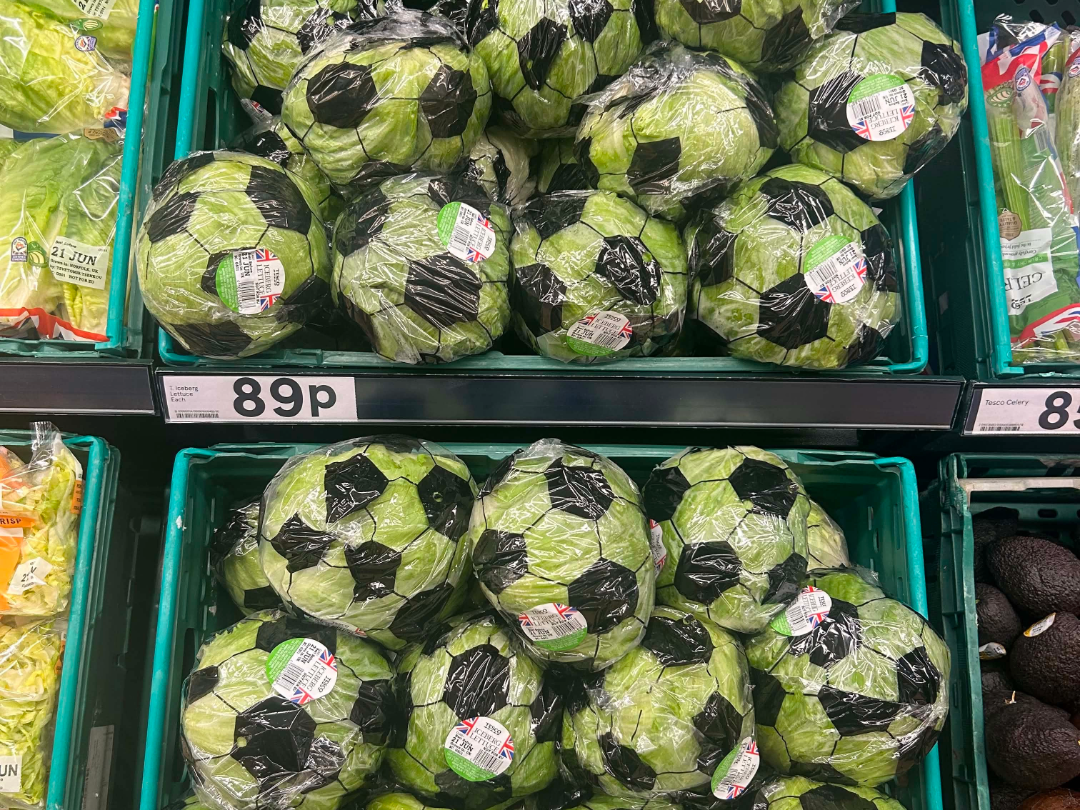
Tesco has repackaged its iceberg lettuces in a football-themed design to celebrate the FIFA World Cup 2026 – a move hoped to encourage families and children to eat healthily during the tournament.
Developed in collaboration with G’s Group, the new packaging applies a football-inspired print to the transparent film already used to package Tesco’s iceberg lettuce.
Saydee Calvert, buying manager at Tesco, commented: “To celebrate the World Cup, we’ve given a salad staple a football-inspired makeover, connecting a healthy product to one of the biggest sporting events of the year, creating some excitement at the shelf edge while showing how Tesco can make healthier choices relevant to key customer moments.
“It’s a simple idea, but a great way to show families and children that healthier choices can still be relevant, seasonal, and fun.”
“It’s fantastic to be able to do something a bit different with our packaging during a massive cultural moment,” G’s Group commercial director Andy Speechley told the Fresh Produce Journal. “The iceberg footballs give real stand-out on shelf and provide a healthy alternative to lots of the other World Cup initiatives going on in stores.”
“Great to work on such an exciting project,” reads a post on the official G’s Group LinkedIn account. “Lettuce hope we can align eating healthy during the World Cup with success on the pitch for England and Scotland!”
The new design has garnered positive responses online, with publications and social media users praising the idea’s simplicity.
“Such a simple idea but absolutely gold,” writes Jamie Laing, co-founder of Candy Kittens. “I’ve seen lots of brands jumping on the World Cup hype recently. It has felt for some time like every time there’s a big event - sporting, cultural, or otherwise - brands flock to get involved.
“It can be a good thing, I’ve seen lots of awesome reactive creative work, but it can also sometimes feel like brands are overcomplicating/overhyping a moment for the sake of tapping into an audience who are never going to buy their products.
“This feels like a top-tier bit of reactive marketing. So simple, immediately obvious, and does some good: makes the World Cup a reason to make a healthier choice.”
“Innovation doesn’t always have to be the brand-new shiny thing,” continues food business advisor Louis Bedwell. ”Tesco is doing some good work at the moment to pull people into the fruit and veg aisle, making it fun and exciting.”
He notes that the packaging is promoting health “without health language” and ”not changing the product, but using the packaging to create salience where most products look the same” – an approach he describes as “borrowing from FMCG.”
“Rather than launching yet another spin-off product, Tesco plays with what it already has on the shelves and reinterprets it to reflect current sporting events,” observes Maxime Delmas for creative media and advertising agency Creapills.
“It’s experiential marketing on a package scale: no heavy-handed approach, just an immediate connection that transforms a grocery chore into a small moment of shared enjoyment.
“By placing a football in the basket, Tesco offers parents an unexpected angle of attack to get their children to eat salad. The seasonality of the event does the rest: the iceberg lettuce becomes the natural companion for match nights, and the engagement strategy works without ever feeling like a nutrition lesson.”
On its Instagram account, Mad About Marketing comments that the packaging “make[s] a simple, low-interest product more exciting and appealing.”
“By packaging iceberg lettuce to look like a football, it grabs attention and changes how people see it,” the post reads. “It also connects the product to the FIFA World Cup without needing official sponsorship, using cultural hype to boost interest and sales.”
Instagram user @marketingwaves.in adds that the “low-cost, high creativity move” has “turned a regular grocery item into one of the most shareable marketing moments” – describing the packaging as “proof that smart ideas > big budgets.”
However, flexible plastics have posed a challenge on the sustainability front. CEFLEX has just reported that EU Member States must source an additional 440,000 tonnes of post-consumer recyclate from flexible polyolefins annually to meet the Packaging and Packaging Waste Regulation’s recycled content targets, while the Alliance to End Plastic Waste advocates for separate waste collection, post-consumer recyclate targets, and extended producer responsibility as potential solutions in its recent report.
Packaging Europe previously visited Tesco to try out the next-generation QR codes on its own-brand sausage packaging. Set to replace conventional barcodes, the new codes are intended to provide up-to-date information such as use-by dates and recyclability instructions, but they have inspired mixed responses on social media.
We have also published a guide to the essential packaging developments during the World Cup season, from the controversy surrounding FIFA’s last-minute ban on reusable bottles (and its effort to backtrack after public outcry) to PepsiCo’s limited-edition thermochromic cans offering fans the chance to win exclusive prizes.
If you liked this story, you might also enjoy:
The ultimate guide to packaging innovation in 2026
Packaging and Packaging Waste Regulation: what to know in 2026
Everything you need to know about global packaging sustainability regulation


In this edition of The Spotlight, Markem-Imaje examines how 2D coding is redefining the role of flexible packaging and


The material that consumer and industrial (C&I) applications rely on just got a sustainability upgrade. DuPont talks us


Utilizing vacuum aluminizing and laser-writing technologies, Shunho Creative (a sub-brand of Shanghai Shunho International) has developed a plastic-

Seeking to meet the challenges of the climate crisis and regulatory changes, Smurfit Westrock is investing in its manufacturing network,

ATS-Tanner’s banding solutions aim to reduce packaging waste, provide a practical alternative to plastic and improve recyclability. In

Cirkla, Belmark and Ossid have unveiled the ‘world’s first’ resealable fibre tray, intended as a sustainability-minded, scalable, and

In its latest paper, The Consumer Goods Forum has set out packaging design guidelines to avoid pollution, increase recycling rates,

Smurfit Westrock, AB InBev and JKR have designed a fibre-based packaging concept that carries one bottle of alcohol-free

Cazcabel Tequila has redesigned the bottle for its Blanco and Reposado tequilas, with the new 70cl bottle rolling out in