
‘Paperization has moved beyond a simple substitution story’
We see negative packaging-related stories every day, but what is your favourite good news packaging story from the past
We see negative packaging-related stories every day, but what is your favourite good news packaging story from the past

In the latest edition of the Spotlight, Matthew Wright, Founder and CEO of FOREST-PKG, shares why finding the right
Cirkla, Belmark and Ossid have unveiled the ‘world’s first’ resealable fibre tray, intended as a sustainability-minded, scalable, and

FIFA has made a last-minute decision to ban reusable bottles in stadiums during the World Cup 2026, sparking debate over whether fan safety is coming second to shareholder profit.
The World Cup’s policies on beverage containers have been widely discussed in recent years. Football players and fans alike have expressed concerns surrounding the health impacts of rising temperatures, both on the pitch and in the stands.
Scientists from the World Weather Attribution have predicted that approximately 25% of this year’s matches will be played in temperatures exceeding 26°C, while 5% will take place in over 28°C.
Last month, FIFA told The Athletic that spectators would be permitted to bring one factory-sealed water bottle if the weather forecast predicted high temperatures.
A graphic was circulated to inform ticketholders that they could bring a plastic reusable bottle with a capacity of up to 1L (33.8 oz) – so long as it was transparent, label-free, and filled only inside the stadium. Glass and hard thermal materials were not permitted.
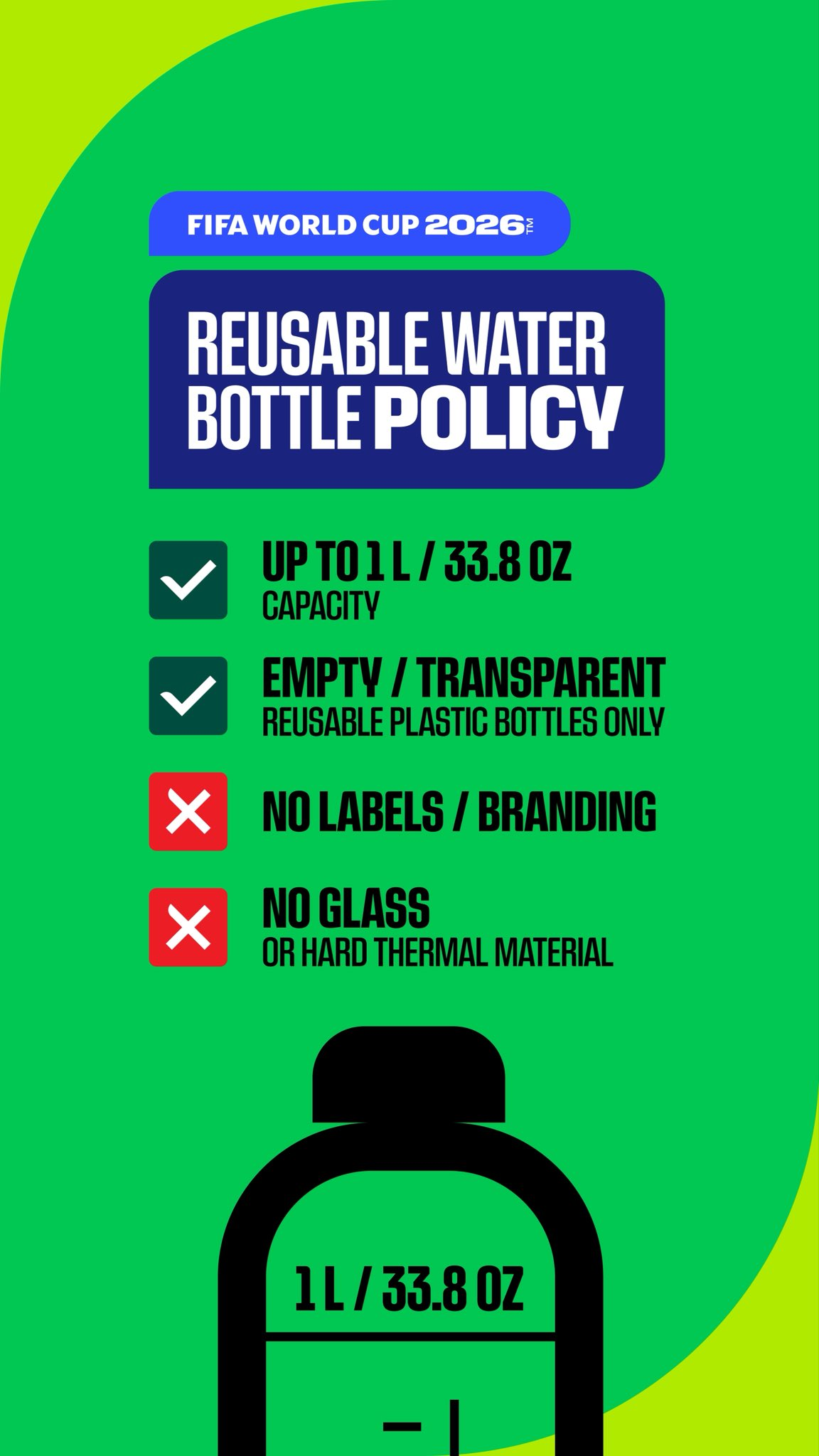
Now FIFA has updated its Code of Conduct and notified ticketholders that reusable bottles are no longer permitted in football stadiums. The guidance also bans ‘bottles, cups, cans or any other form of closed or capped receptacle that may be thrown or cause injury’.
Only baby milk, sterilized water in containers, and liquids required for medical reasons (accompanied by a medical certificate in English, French or Spanish) are exempt from the rule.
FIFA told The Athletic that the decision was made to protect players and attendees from injury, adding: “Outside bottles are already prohibited at several of these venues for safety considerations, and FIFA is applying this consideration across its tournament stadiums.”
Fans have described the measure as “disgusting” and “evil”, with one commenting: “Even the greediest American sports owner knows that they have to concede letting people have reusable bottles during the summer because people might die otherwise. What FIFA is doing here is on a whole other level.”
Another has questioned the logistics of the ban, predicting “a disaster with nowhere near enough water easily available in the stadium to create ginormous queues, a shortage, and ultimately thousands of fans suffering absolutely needlessly, potentially drastically, all for a buck.”
A third acknowledges that the rule already existed in several of the host venues, but adds: “They say hydration stations will be available, but outside the stadium, not inside. You’re sitting in 28°C heat with no bottle and two options: buy their water or walk out.”
The Football Supporters’ Association (FSA) has also opposed the new policy: “In all of our discussions, free water availability in stadiums was a key one. We were assured by FIFA that this would be the case, and that fans will have the ability to bring their own water bottle.
“For all of the effort [FIFA] are going to with ‘drinks breaks’ for the players, this is such a strange, late change […] Naturally, the immediate thought from supporters is this is just the latest money-grab.”
A spokesperson told The Athletic that the welfare of the spectators should be FIFA’s priority “and not the ability to sell more bottled water at inflated prices.”
According to the publication, FIFA venues have previously charged between $4 and $6 for bottled water. While it has not confirmed this year’s prices, it has assured fans that pricing “will remain consistent with other events held at each stadium.”
However, some sources have pointed to FIFA’s long-term partnership with Coca-Cola – speculating that the new policy will maximize the sponsor’s profits by forcing spectators to buy its Dasani water brand on-site.
Restricting fans to single-use bottles also has environmental implications. During the preliminary draw for the 2018 World Cup, FIFA reported that it had sent 107kg of plastic bottles for recycling, alongside 655kg of polyethylene packaging and 790kg of cardboard and paper – yet The Guardian described these figures as “woefully imprecise” and “wildly inaccurate”.
“FIFA got through 5,632 non-reusable bottles and threw out 176,000 pieces of unnecessary paper, and then declared its sustainability program a success,” said sports writer Simon Burnton.
Yet FIFA World Cup Dallas has shared its approach to sustainability at Dallas Stadium in Arlington, including plans to implement a ‘comprehensive’ waste management programme with a focus on reducing single-use plastics, recycling and recovery, composting, and reducing food waste.
In other news, PepsiCo has kicked off a football-themed brand campaign with limited-edition thermochromic cans that change colour at the ‘optimal’ drinking temperature and give fans the chance to win exclusive prizes.
Coca-Cola North America has also teamed up with Panini America to celebrate the FIFA World Cup 2026 with peel-back labels revealing collectable stickers on select bottles.
If you liked this story, you might also enjoy:
The ultimate guide to packaging innovation in 2026
Packaging and Packaging Waste Regulation: what to know in 2026
Everything you need to know about global packaging sustainability regulation

In the latest edition of the Spotlight, Matthew Wright, Founder and CEO of FOREST-PKG, shares why finding the right


In this edition of The Spotlight, Markem-Imaje examines how 2D coding is redefining the role of flexible packaging and


The material that consumer and industrial (C&I) applications rely on just got a sustainability upgrade. DuPont talks us


Utilizing vacuum aluminizing and laser-writing technologies, Shunho Creative (a sub-brand of Shanghai Shunho International) has developed a plastic-

Seeking to meet the challenges of the climate crisis and regulatory changes, Smurfit Westrock is investing in its manufacturing network,

We see negative packaging-related stories every day, but what is your favourite good news packaging story from the past

Cirkla, Belmark and Ossid have unveiled the ‘world’s first’ resealable fibre tray, intended as a sustainability-minded, scalable, and

In its latest paper, The Consumer Goods Forum has set out packaging design guidelines to avoid pollution, increase recycling rates,

Smurfit Westrock, AB InBev and JKR have designed a fibre-based packaging concept that carries one bottle of alcohol-free