
SIG creates bag-in-box fitment to dispense food and drink smoothly
SIG has revealed a bag-in-box fitment for easy connection and flexible dispensing in foodservice operations. SIG CleanClic Connect
SIG has revealed a bag-in-box fitment for easy connection and flexible dispensing in foodservice operations. SIG CleanClic Connect

The company's new ice cream packaging solution is made from up to 85% paper from FSC™-certified forests
Bringing sustainability-minded ideas to market requires us to think outside the box and address familiar challenges from a different

Tesco is replacing traditional barcodes with next-generation QR codes on its own-brand sausage packaging, intending to provide up-to-date information such as use-by dates and recyclability instructions.
After the new packaging was met with mixed responses on X, Packaging Europe visited a Tesco store to try out the new code for ourselves.
Last year, Tesco and GS1 announced a trial in which QR codes would be applied to twelve own-brand meat and produce lines in a handful of Tesco locations across southern England.
Like traditional barcodes, these QR codes are set to provide a unique digital identity for each product; but they are also expected to carry ‘significantly more’ information per code and give consumers instant access to accurate, real-time supply chain data.
For example, the initiative sought to capture use-by dates and batch numbers. This was hoped to improve the real-time accuracy of date codes, cut down on in-store spoilage and food waste, and prevent the retailer from selling out-of-date products.
GS1 and Tesco anticipated that more information could be introduced in the future, including allergen information, sourcing and sustainability credentials, and recycling guidance.
“As well as improving the customer experience and unlocking new supply chain value, we are testing how QR codes can help Tesco with issues including traceability, compliance, sustainability and shelf-edge communication,” said Isabela De Pedro, supply chain development and change director at Tesco.
Now Tesco has announced that its entire own-label core sausage range – namely its 8 and 12 Tesco Pork Sausages, 12 Tesco Pork Chipolatas, 12 Tesco British Pork Sausage Meat, 12 British Cumberland Sausages, and 8 British Lincolnshire Sausages products – is making a full transition into QR codes.
Linear barcodes will remain on branded products during the transition period, the retailer says. However, it hopes that the new QR codes will unlock ‘tangible benefits’ for consumers, employees, and the environment.
“For customers, this is a tiny and almost invisible change at the checkout, but for the retail industry it’s a significant step forward,” comments Peter Draper, development and change director at Tesco. “Moving to QR codes will help us reduce food waste, improve stock control and unlock new digital benefits for our customers.
“Customers will continue to shop and pay in exactly the same way, but they’ll have the option to access far richer information about the products they buy simply by using their smartphones. Over time, this opens up exciting possibilities, such as personalized digital tools to help customers manage the food they buy and reduce waste at home.”
One consumer shared a photo of the on-pack barcode on X this week, and the post inspired a variety of opinions.
“Will it contain [the] sell-by date and get stopped at [the] till if out of date?” one user asked. “[It will] be interesting to see how it works. Dates on sausages [were] something I complained about often when I [worked as a merchandiser] for Tesco.”
“Clever,” another user commented. “Scan it with a phone and you get taken to the product’s page on their website. Nice to see the use by date in it too. Must save so much time managing stock as they’ll know how many are still on the shelves which are bad.”
Others were less enthusiastic, with one user saying: “QR codes [are] famously a nightmare to scan, not sure this helps!” Another agreed with this point, adding: “It usually just ends up being more of a technical headache than it’s worth.”
We decided to test it out for ourselves and purchased a pack of Tesco’s 8 British Pork Sausages for a hands-on demonstration of the new QR code’s capabilities.
The packaging draws attention to the new code with a blue banner reading ‘NEW BARCODE – SCAN TO PAY’. While a use-by date was still provided on-pack, it was preceded by the QR code itself – and when scanned with a smartphone, it revealed a dedicated product listing, which indicated that the product would stay fresh for over five more days.
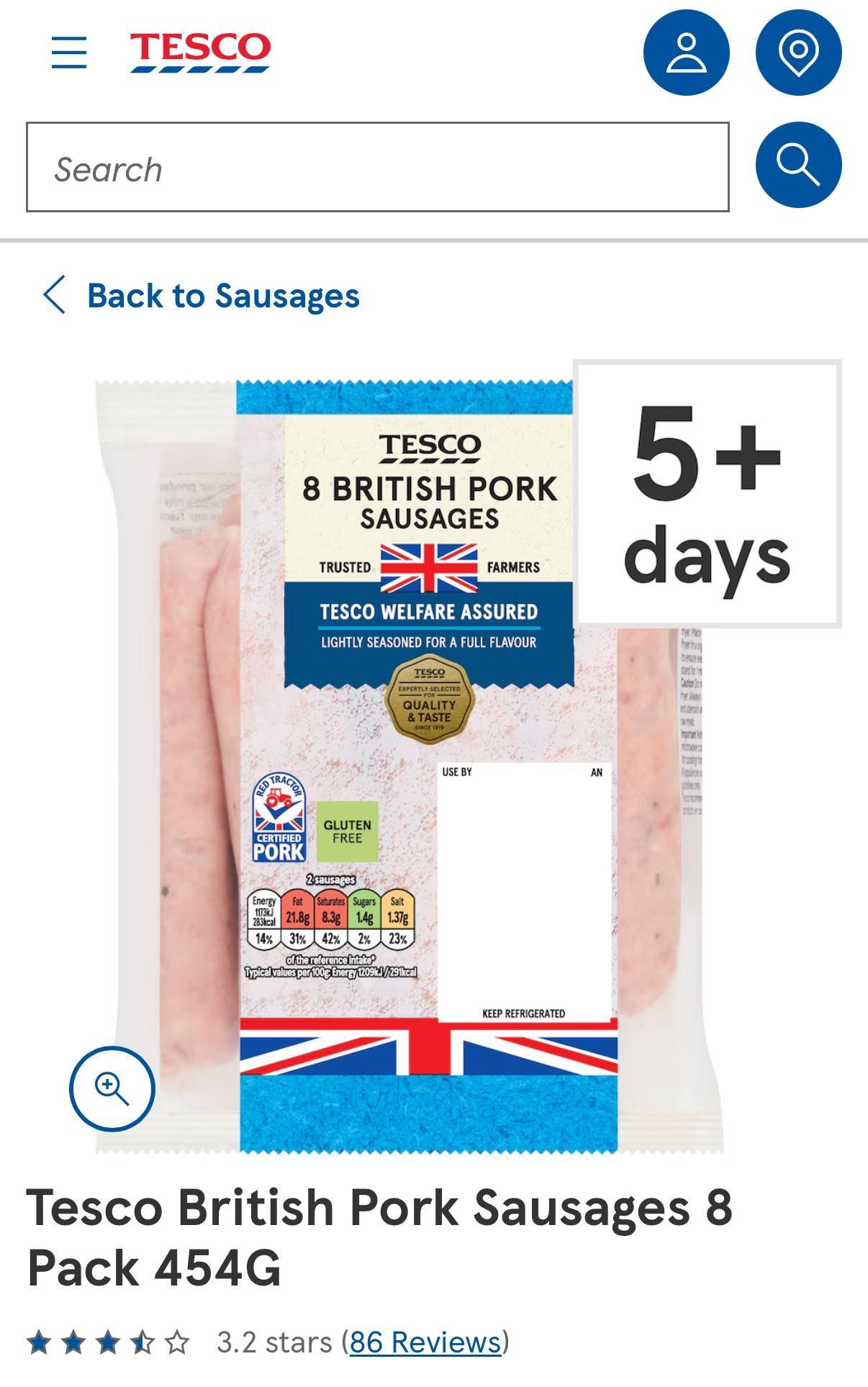
The page provided much of the same information as the package itself, including the product’s nutrition information, ingredients, storage and preparation instructions, and guidance for recycling the packaging at end-of-life. In this case, the consumer is told to bring the empty packet to an in-store recycling point.
However, our journalist noted that the text was larger on a phone screen than the package itself, and found it easier to read on a flat screen than the flexible plastic, which obscured the text when it creased.
QR codes are often linked to accessibility, especially for shoppers with visual impairments or learning disabilities. While Tesco’s QR code does not yet provide audio descriptions, our journalist felt that the information was less overwhelming on a phone screen; clear titles divide the text by topic, and drop-down menus allow the user to open and close sections at will.
The scanning experience may differ per consumer, especially if the user is not well-versed in self-checkout technology. The functionality of individual machines, including the cleanliness of the scanner, may also play a role, as one X user explains. Our journalist felt that the QR code was marginally harder to scan due to its smaller size, but reports that the scanning process was familiar and intuitive, with the self-checkout machine recognizing the product as normal.
In other news, Delhaize has undertaken a similar initiative in Belgium. It has packaged its strawberries in cardboard boxes with on-pack QR codes leading shoppers to informations about the strawberries’ origins, the local grower, and the cultivation method, as well as suggested recipes.
If you liked this story, you might also enjoy:
The ultimate guide to packaging innovation in 2026
Packaging and Packaging Waste Regulation: what to know in 2026
Everything you need to know about global packaging sustainability regulation


In this edition of The Spotlight, Markem-Imaje examines how 2D coding is redefining the role of flexible packaging and


The material that consumer and industrial (C&I) applications rely on just got a sustainability upgrade. DuPont talks us


Utilizing vacuum aluminizing and laser-writing technologies, Shunho Creative (a sub-brand of Shanghai Shunho International) has developed a plastic-

Seeking to meet the challenges of the climate crisis and regulatory changes, Smurfit Westrock is investing in its manufacturing network,

ATS-Tanner’s banding solutions aim to reduce packaging waste, provide a practical alternative to plastic and improve recyclability. In

SIG has revealed a bag-in-box fitment for easy connection and flexible dispensing in foodservice operations. SIG CleanClic Connect

The company's new ice cream packaging solution is made from up to 85% paper from FSC™-certified forests

Bringing sustainability-minded ideas to market requires us to think outside the box and address familiar challenges from a different

PackIntelX has developed EasyDoC, a digital solution intended to help smaller businesses complete Declarations of Conformity and comply with the