




Over the last 16 months, Nestlé has taken part in a consortium alongside 8 other partners to pilot Zest’s AI-led solutions to visualize and reduce food waste and redistribute surplus to people, supporting an estimated 94,133 people across various charities and organisations.
The project aims to demonstrate how these solutions can be scaled at speed to build a more efficient food sector. The main impacts of the food waste project included 4.8 tonnes of edible food surplus newly identified on a production line and sold for human consumption over animal feed, reportedly resulting in a 15 times increase in revenue from surplus, and 201.9 tonnes of food surplus redistributed to people.
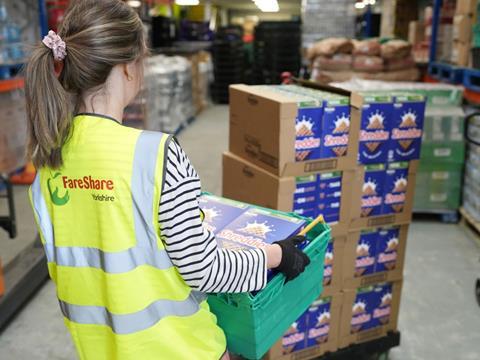
Convened by Sustainable Ventures, the collaboration involved piloting Zest’s solutions within Company Shop Group, FareShare and Nestlé’s real-time business environments to work through the technical and operational complexities for scaling. The scope, feasibility and benefits of the solutions were tested with Bristol Superlight, FuturePlus, Google Cloud and Howard Tenens to de-risk full scale implementation. The project was funded through a £1.9 million match-funded BridgeAI grant from Innovate UK.
Nestlé says the pilot demonstrated how AI can enable connecting siloed data points on a manufacturing line, to map where food waste and surplus is generated in real time and identify actions to reduce and redistribute it. Early comparisons indicate ‘strong potential’ for AI to improve speed, accuracy, consistency and predictability of data analysis versus manual waste assessment.
Zest trialled its solutions with several other food manufacturers during the project. In one trial, it claims the AI-led process halved the speed of the manual process and quadrupled the amount of food waste identified.
Sustainable Ventures has produced a White Paper titled ‘On the table: Scaling AI-led food waste and surplus visibility, reduction and redistribution’ which recommends how these solutions could be scaled. It suggests that food manufacturers could look to adopt solutions that use AI data to boost speed, give real life data insights and gather more data to deliver lasting operational changes such as reductions in food waste.
It also recommends reaching a consensus on a single surplus food redistribution platform that can streamline and match food manufacturers and redistribution organisations’ food. Sustainable Ventures specifies that there needs to be a critical mass of food surplus supply and demand organisations using it to unlock its full efficiency benefit.
Last year Nestlé’s R&D team collaborated with IBM Research to develop new AI tools, including one said to be capable of proposing new high-barrier packaging materials for shielding products from moisture, oxygen and temperature changes. Scientists from both companies utilized AI-based processing techniques to construct a knowledge base of known materials from public and proprietary documents.
A few months later, Tetra Pak launched its Automation and Digitalization portfolio, Tetra Pak Factory OS, a suite of ‘modular, open and scalable’ smart factory technologies designed for food and beverage production, aiming to ‘lay the foundation’ for AI-ready factories. The portfolio features a data integration platform which connects equipment and systems throughout the factory to unify data into one real-time view.
If you liked this story, you might also enjoy:
The ultimate guide to packaging innovation in 2026
Packaging and Packaging Waste Regulation: what to know in 2026
Everything you need to know about global packaging sustainability regulation
















No comments yet