




In this edition of our ‘In Conversation With…’ series, Jerome Zhang, senior R&D engineer at YUTO, walks us through the Ecocoon™ buffer material: its sustainability metrics as a plant-based material, and its potential benefits as an alternative to petroleum-based plastics.
What is Ecocoon™? What challenges or roadblocks does it address?

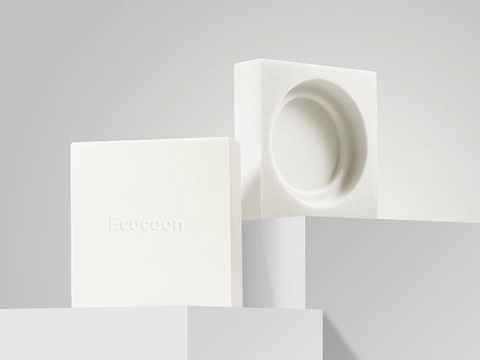
Ecocoon™ is a new kind of protective packaging stuffing. Instead of being made from petroleum-based plastic foams (like the common white EPS foam or the soft EPE foam), it’s crafted from plant fibers. The real magic is in how it’s made. YUTOECO is using a special “air-laid” process that’s been fine-tuned to work perfectly.
It’s designed to solve the headaches that come with other eco-friendly packaging materials, such as corrugated paper, honeycomb paper, pulp molding, and so on. For example: it doesn’t need time and labor for folding and shaping as corrugated paper and kraft paper, making it especially suitable for irregular shaped items. Compared to honeycomb paper and pulp molding, it needs far less water and energy consumption, streamlines manufacturing, and delivers reliable cushioning performance.
What applications would you suggest for this material?
Ecocoon™ is suitable for a wide range of applications requiring high-performance, sustainable protection, particularly where customization and complex shapes are needed. For example, for high-end electronics such as motherboards and precision instruments, it provides a clean, non-abrasive surface that protects delicate circuitry and fine pins.
In the meantime, it can also hold heavy-duty and fragile goods such as auto parts, glassware, and machinery. Its dry-process, elastic fiber network offers superior energy absorption and resilience, effectively dispersing shock and vibration during transit, providing more reliable cushioning than molded pulp or certain bioplastics that can be brittle or deform easily. For certain luxury & premium consumer goods, Ecocoon™ can be precisely molded to achieve elegant, customized shapes that securely cradle products. Its natural, premium aesthetic elevates the unboxing experience while ensuring excellent protection.
So, here is the bottom line: Whenever you need eco-friendly cushioning that’s form-fitting, durable, and intricately shaped, Ecocoon™’s dry molding process gives you unmatched design freedom, i.e., creating custom protection in one piece, with no need for cutting or gluing afterward.
Has it passed any performance or biodegradability tests?
It has already passed impact and drop tests, proving it can reliably protect sensitive items like electronics throughout shipping and handling. It has also passed halogen and heavy metal testing, so it’s safe for direct contact with components and meets global safety standards like RoHS.
While we’re still completing the formal biodegradability testing, the product is made from renewable plant fibers, so we’re fully confident it will break down naturally. It’s a new launch, but built with sustainability and performance in mind from the start.
How does the production process differ from plastic cushioning materials?
The key differences come down to the raw materials, the manufacturing process, and the environmental impact.
Firstly, most plastics are derived from non-renewable petroleum-based polymers, while Ecocoon™ is made from renewable plant fibers, a sustainable resource.
Then, for the production process, plastic involves energy-intensive extrusion or expansion using chemical foaming agents. Ecocoon™ utilizes a dry air-laid web forming + one-step molding process to shape it directly into its final form, so there’s no need for chemical blowing agents, and produces zero exhaust gas. Components are molded to their final shape directly, eliminating the need for extra steps like cutting, folding, or gluing.
Finally, as for the environmental impact, plastic foam often means high energy consumption, usually relies on fossil fuels, is generally not biodegradable and carries the potential for microplastic pollution.
Ecocoon™ is characterized by lower energy consumption, zero exhaust gas, and a significantly reduced carbon footprint, and is fully biodegradable at the end of its useful life — making it a cleaner, greener choice from start to finish.
What is the storage life, and will its performance change over time?
It is important to remember that “biodegradable” doesn’t mean it breaks down right away in any environmental conditions. The process needs: the right microbes, moisture, temperature and oxygen. In a typical warehouse—dry, cool and indoors—these conditions aren’t met, the material stays stable and does not degrade.
When stored properly (indoors, away from heat and sunlight), Ecocoon™ has a shelf life of at least 2-3 years. Its protective performance stays strong the whole time—more than enough to cover every step of the supply chain, from production and storage to shipping and final delivery.
What are the next steps for Ecocoon™?
To support our R&D innovation, we also have our own YUTOECO R&D Institute, dedicated to pioneering eco-friendly materials and sustainable packaging technologies. Right now, our team is focused on a few key goals for Ecocoon™:
First, scaling up to full mass demand.
Second, enhancing the material with added functionalities—like water resistance or antibacterial properties—to expand its use across more industries.
And third, helping brands who adopt Ecocoon™ to actually measure and verify their carbon savings—an increasingly important factor as companies work to meet sustainability targets.
These efforts are rooted in YUTOECO’s mission: to be a reliable partner for sustainable packaging innovation, turning our vision of a Green Life for Everyone into reality.
To learn more about Ecocoon and YUTOECO’s other product offerings, click here.














No comments yet