
Nivea Creme tin now made from 95% recycled aluminium
Novelis and Beiersdorf have announced that the iconic Nivea Creme tin is now made from 95% recycled aluminium. The companies
Novelis and Beiersdorf have announced that the iconic Nivea Creme tin is now made from 95% recycled aluminium. The companies

MYGroup is rolling out a take-back network to recycle beauty packaging made from Shellworks’ plant-based, compostable biomaterial – aiming
Happy Products has unveiled a ready-to-drink coffee line in eight collector’s edition cans to celebrate Marvel Studios’

Theegarten-Pactec has announced its FPC6 flow-wrapping machine for manufacturers of foods including chocolate, confectionery and protein bars, said to combine ‘outstanding’ flexibility with advanced user-friendliness, digital networking and maximum process reliability.
Apparently, the new development is also suitable for co-packers and contract packers and enables a fully automated packaging process as a system solution. With the new machine, the company is also implementing an automated system from a single source, which transfers the flow packs directly to the BLM high-performance cartoner developed in-house.
The FPC6 processes a variety of product formats without major retooling and has cold sealing, heat sealing and cut-seam welding options for water-soluble films. An integrated preheating section allows sensitive materials such as paper or recyclable mono films to be processed, even in high-performance operation.
With the new system, Theegarten-Pactec aims to enable customers to operate their systems independently, reliably and with a high degree of efficiency, through improved identification of error causes and their effects. Visualisations on the touch panel and graphic replacement images provide operators with targeted support in systematic troubleshooting, even if the cause and the fault are physically separated.
For example, if the machine recognises when faults at the machine outlet are caused by upstream process steps (such as the synchronisation of unpackaged products), the company says the control panel would specifically indicate possible sources, reducing downtime and avoiding unnecessary interventions.
Theegarten-Pactec adds that when changing format, all relevant settings are recorded electronically and stored in the recipe management system. Electronic counting scales ensure repeat accuracy during format changes, and manual adjustments via trial and error are no longer necessary.
Critical components can be removed and cleaned without tools. All replaceable components are designed in line with the ‘poka-yoke’ principle (a Japanese method for avoiding errors in production and work processes), which prevents incorrect installation.
The company also seeks to consistently simplify product feeding. Instead of replacing the entire product lug chain, operators can replace individual lugs of the chain when changing formats. This allows a format-specific arrangement to be created without removing the entire chain, ideally matching the packaging process to the product and packaging material. At the same time, mechanical stress is reduced.
According to Theegarten-Pactec, the shatterproof Makrolon cladding means the machine’s contamination level is always visible, such as in the case of batch-related changes such as soft chocolate. Thanks to the transparency also means the wear status of central components can be detected during operation.
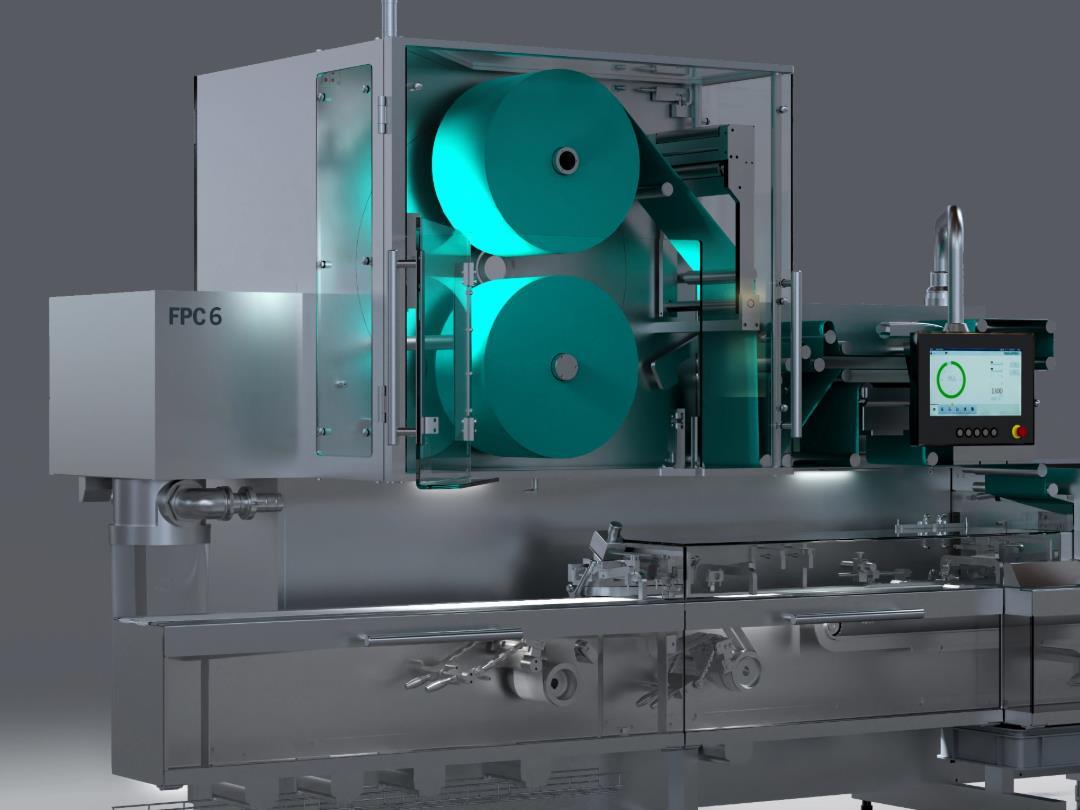
The FPC6’s ‘flying splice’ technology apparently eliminates previously required steps in the unwinding process, such as precise threading and sticking on a double-sided adhesive strip. A roll prepared with adhesive tape is placed on the machine with no further steps needed. Roll changes can also be carried out without reducing speed, even at packaging speeds of 150 m/min.
The machine’s web edge control also allows the course of the film web to be adjusted directly on the HMI (Human-Machine Interface) - for example, depending on the batch or when changing flavours. Old and new values are automatically stored in the recipe management system. Manual settings that were previously necessary are no longer required, and the original target value is retained.
The integrated control cabinet has been designed to reducs space requirements, as all electrical and electronic components are integrated at the rear of the machine, eliminating the need for a separate footprint.
The company adds that the cross-sealing unit can be replaced without tools, guided (largely automatically) via the HMI, and can be carried out using a conventional manual pallet truck. When the new sealing unit is inserted, a forced guide ensures automatic centering. The machine automatically recognizes the cross-sealing device that has been inserted and connects all mechanical and electronic components.
The manual gear readjustment previously needed when changing the sealing gap is no longer required, which ‘significantly reduces’ wear and increases component longevity. At the same time, the quality of the seal seam remains stable, regardless of re-adjustments.
Theegarten-Pactec states that the FPC6 is designed as both a stand-alone solution and as part of an integrated system solution. From the unpackaged product to the carton, everything comes from a single source including distribution systems, storage and feed components. The entire process is fully automated without the need for manual intervention, said to increase hygiene and process reliability, reduce personnel costs and minimize interface risks within the line.
In related news, Syntegon launched its Pack 103 entry-level flow wrapping machine last year, designed to offer efficiency and ease of use to small and medium-sized businesses, with an output of up to 175 packs per minute. It features a touchscreen interface aiming to allow operators to easily adjust settings and fast format changes to allow businesses to adapt to changing production demands.
This month Poly-Clip launched its clip-pak concept designed for liquid and ‘paste-like’ foods, where products are filled into a flexible film or synthetic casing tube and securely closed and portioned with clips. Suitable for products such as soups, sauces, or stocks, it is said to enable space-saving storage, efficient transport and easy handling.
If you liked this story, you might also enjoy:
The ultimate guide to packaging innovation in 2026
Packaging and Packaging Waste Regulation: what to know in 2026
Everything you need to know about global packaging sustainability regulation


In this edition of The Spotlight, Markem-Imaje examines how 2D coding is redefining the role of flexible packaging and


The material that consumer and industrial (C&I) applications rely on just got a sustainability upgrade. DuPont talks us


Utilizing vacuum aluminizing and laser-writing technologies, Shunho Creative (a sub-brand of Shanghai Shunho International) has developed a plastic-

Seeking to meet the challenges of the climate crisis and regulatory changes, Smurfit Westrock is investing in its manufacturing network,

ATS-Tanner’s banding solutions aim to reduce packaging waste, provide a practical alternative to plastic and improve recyclability. In

Happy Products has unveiled a ready-to-drink coffee line in eight collector’s edition cans to celebrate Marvel Studios’

Pregis has expanded its Sharp product range with the launch of InfinX – a new a new on-demand system that

Post-COVID, and after the subsequent adjustment period, what new trends are affecting the packaging industry? Neil Osment, Managing Director

BioPak’s Huskee brand has developed an intelligent, IoT-enabled Smart Bin for reusable cups and containers – intended to simplify