




The Fair Resource Foundation filed an enforcement request against McDonald’s Netherlands for breaking Dutch law and serving single-use cups to dine on-site. It resulted in a penalty notice.
Project coordinator Chloé Schwizgebel provides behind-the-scenes insight into the campaign and investigation, and what any of it means for reuse initiatives in the fast food sector.
Please could you explain this latest piece of news for our readers – what exactly has happened here?
In the Netherlands, McDonald’s was breaking the law by serving its customers in single-use plastic cups. So, we reported this to the Dutch Inspection in November 2025.
The Inspection investigated the issue and confirmed that our report was accurate: McDonald’s Netherlands is breaking Dutch law on single-use plastic packaging, which requires the HORECA sector to serve its customers in reusable cups for dine-in, rather than single-use plastic cups.
The Inspection has now officially issued an injunction for the fast-food chain to comply with this rule, which it has been breaking since August 2024.
If McDonald’s Netherlands fail to comply by January 5 2027, they will be charged a penalty of €625,000 per week, and up to €3.75 million (6 weeks).
Fair Resource Foundation’s campaigning on this issue has been live for almost a year now. Could you take us behind the scenes and explain how the campaign evolved from start to finish?
The campaign started when we realized from reading through a report from McDonald’s Corporate that the results of the reuse system in Dutch McDonald’s were very poor compared to their counterpart in France (performance measured in ‘average number of uses’ of the cups, with France managing to reach 33.9 uses versus only 3.3 in the Netherlands, so 10 times lower).
We wanted to investigate why the Dutch system was scoring so poorly. Therefore, we went with colleagues to visit a dozen restaurants in various Dutch cities. And every new restaurant we visited brought new, unexpected surprises.
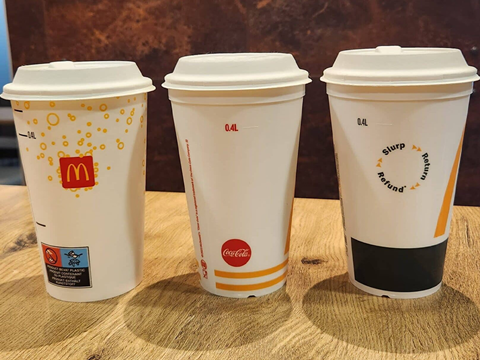
The reuse system was obviously poorly designed: a confusing ordering menu, offers of single-use cups for dine-in, hard-to-differentiate single-use vs. reusable cups, and a single-use carton lid on all of them.
This is when we realized that not only had McDonald’s designed its reuse system poorly, but that they were also breaking the Dutch law by offering single-use plastic cups and making their clients pay a surcharge for it, therefore making money by breaking the rules. This is why we published our investigation online, alerted the media, and reported them to the Dutch Inspection.
Since then, we even tried to establish contact with McDonald’s Netherlands to discuss their system and see whether it was possible to work together on improving their practices. From that meeting, it became clear that they didn’t believe in reuse as they restated what is present in their Impact Report, namely: “We do not believe in exclusively reusable packaging, but in a mix of solutions.”
In parallel, we also went to witness how the French McDonald’s reuse systems function. In the Netherlands, we also saw the promising results of Burger King’s system.
Over the summer, we did get confirmation that the Dutch Inspection was looking at our enforcement request seriously. In the end, we were pleased to discover last week that McDonald’s Netherlands has been requested to finally comply with the law, after two years of breaking it.
McDonald’s responded to this news by claiming that its “practical experience shows that low return rates for reusable cups can actually lead to increased plastic volume and a higher environmental impact” and that the current rules are not working as intended. What are your thoughts on this?
As mentioned above, through our experience and the results of both McDonald’s France and Dutch Burger King, it is clear that it is not the rules that are the problem. The problem is the way McDonald’s has been designing its reuse system to fail, thereby making the practical experience of its clients difficult, and leading to low return rates. This only shows that McDonald’s hasn’t been working on designing a good system.
We do fear that they will continue doing so in the upcoming month, thereafter again blaming any future poor results on reuse – as opposed to their own design, which is why we will continue scrutinizing their work.
In your view, are there any other clear examples of organisations that could be accused of breaking the law in a similar way? Should companies across the board expect increased scrutiny as a result of this latest enforcement action?
So far, we haven’t witnessed obvious examples of such organisations, but it doesn’t mean that there aren’t any. We do hope that, following the order subject to penalty against the largest Dutch fast-food chain, other organisations will realize that they need to work on optimizing their system. Not only to be compliant, but also to reap the environmental and economic benefits that well-designed reuse systems can provide.
If you liked this story, you might also enjoy:
The ultimate guide to global packaging sustainability regulation in 2026
PPWR timeline: the key dates to know
















No comments yet