
SIG’s new aseptic carton filling machines target high output and flexibility
SIG has expanded its SIG Neo portfolio with new filling machines for aseptic cartons – seeking to offer high output and
SIG has expanded its SIG Neo portfolio with new filling machines for aseptic cartons – seeking to offer high output and

Amcor has unveiled a bespoke, mono-polypropylene flip-top closure for sauce brand Choví, designed to control the sauce’s
SunDance’s new custom coffee valve pouches aim to combine product freshness with flexible, digital printing for low minimum order

Home and personal care brands are starting to embrace paper-based packaging in response to regulatory developments and consumer demand. In this edition of our ‘In Conversation With…’ series, Dirk Endlich, Vice President P2C Division at Elopak, provides deeper insight into this shift – and makes the case for Elopak’s D-PAK™ carton as an effective solution.

Dirk Endlich, Vice President P2C Division, Elopak
The transition towards paper-based packaging is being driven by several factors at the same time. Home and personal care products have traditionally relied on rigid plastic bottles and plastic pouches, meaning changing the packaging format can offer significant opportunities to reduce plastic usage. At the same time, paper-based cartons incorporate renewable paperboard and can be recycled where suitable collection and recycling infrastructure is in place.
What makes the category particularly interesting is the strong alignment between consumer preferences, retailer expectations and regulatory developments. Consumer research conducted in 2024 in the UK and Germany found that 65% of consumers would purchase fabric softener and 59% would purchase laundry detergent in a carton. In addition, 84% of respondents stated that they had no concerns about purchasing liquid refills in carton packaging.[1]
Further consumer studies in 2026 showed purchase intent reaching up to 80% in the UK and 73% in Germany for carton-based home and personal care concepts. The research also highlighted strong associations with practicality, ease of storage and reduced plastic use.[2]
Alongside this growing consumer acceptance, retailers are increasingly incorporating plastic reduction requirements into supplier expectations, while the Packaging and Packaging Waste Regulation (PPWR) is accelerating the industry’s focus on packaging efficiency and circularity. Together, these developments are creating new opportunities for alternative packaging formats within the category.
There are two dimensions to this.
The first is reducing plastic use. A 1-liter D-PAK™ carton contains 9.0g of plastic, compared with 20.1g in an LDPE pouch and 76.7g in a standard polypropylene bottle. The saving comes from a change in packaging format alone.
The second is making the remaining plastic circular and bio-circular. Working with Orkla Home and Personal Care (OHPC) and with Dow, we introduced a new line of D-PAK™ cartons in June 2025 where the thin polymer layer is made from 10% post-consumer circular polyethylene and 90% bio-circular polymers derived from waste and residue streams of biological origin, such as used cooking oil, attributed through a certified third-party mass-balance chain of custody. It is now standard across OHPC’s D-PAK™ portfolio and is already being implemented by other customers.
On the regulatory front, recycled content is a deliberate step taken ahead of the 35% threshold expected for non-food contact-sensitive packaging from 2030 in the EU. By 2030 our European portfolio will comply with those requirements, and the aim is to offer customers solutions that go beyond the minimum.
While material efficiency is an important consideration, businesses increasingly evaluate packaging solutions based on their overall performance throughout the value chain.
D-PAK™ combines several advantages within a single format. Its square footprint shape and stackable structure help optimize transport and warehousing efficiency, improve pallet utilization and maximise available logistics space. This supports more efficient supply chains and contributes to a lower Total Cost of Ownership (TCO) compared with many conventional packaging formats. Third-party assessments indicate that D-PAK™ can offer cost advantages compared with both pouches and HDPE bottles when considering the full packaging system rather than material cost alone.
These efficiencies also extend to retail environments. The space-efficient design helps retailers make better use of available shelf capacity while maintaining strong visibility. In categories traditionally dominated by round plastic bottles, the distinctive gable-top structure helps brands stand out, while the carton’s printable surfaces create 360-degree branding opportunities, providing space to communicate product benefits, instructions and brand stories across all sides of the pack.
Consumer experience is equally important. Beyond its logistics advantages, D-PAK™ was designed with everyday usability in mind. The carton is lightweight, comfortable to carry home and easy to store due to its efficient shape. Its rigid structure supports controlled pouring and remains stable throughout use, while integrated fold lines make it easier to empty and flatten after use.
What is most significant is not a single launch, but the growing diversity of applications.
Today, D-PAK™ is being used across a broad range of liquid home and personal care categories, including laundry detergents, fabric softeners, hand soaps, dishwashing liquids and household cleaning products. OHPC runs D-PAK™ across e.g. Klar, OMO, and Comfort, covering laundry detergent, fabric softener and hand soap.
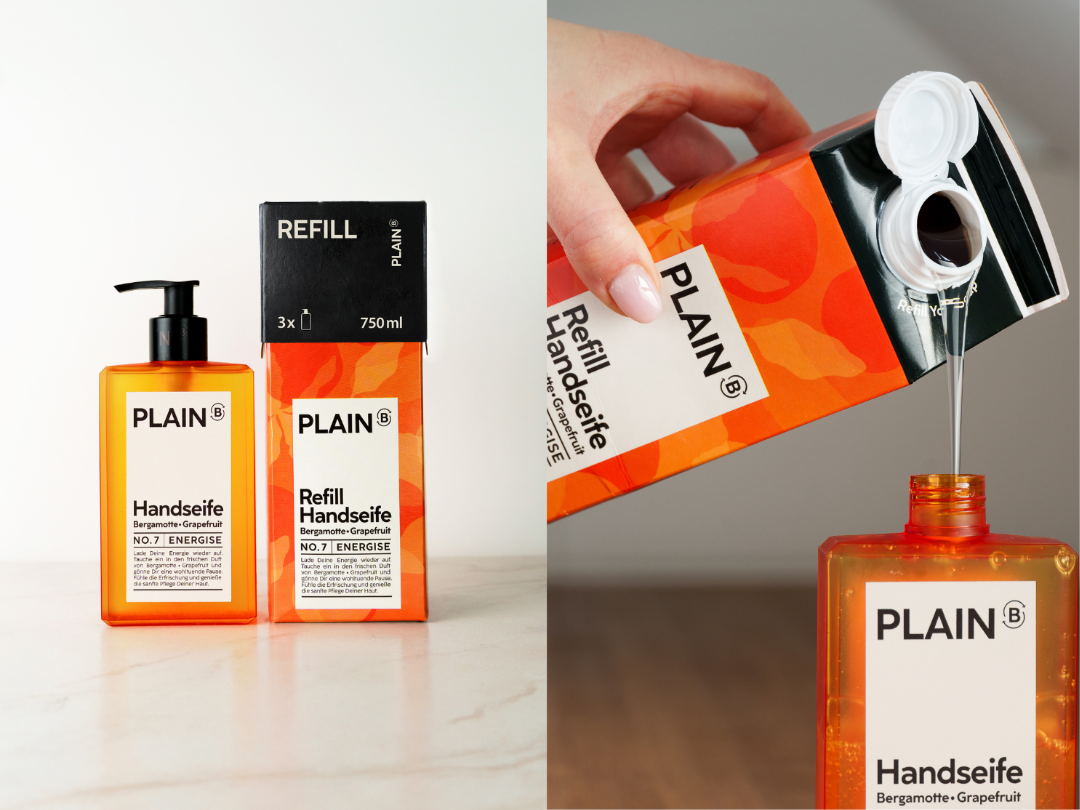
In the Netherlands, Seepje has expanded its refill portfolio for both laundry detergent and hand soap by introducing D-PAK™ alongside refill formats that were previously offered in pouches. In Germany, Freshkind has launched its PLAIN B hand soap refill, where the architecture of the D-PAK™ refill complements the design language of the primary flacon. The format is also used for MilMil’s Alga Bio dishwashing liquid in Italy, Csoaps’ laundry detergent in Norway and McBride’s Actiff household cleaning range.
The breadth of adoption is particularly important because it shows that paper-based packaging is increasingly being recognized as a scalable packaging platform rather than a category-specific solution. Brands are successfully applying the format across different product types, positioning strategies and distribution channels.
Across these examples, brands are using the format to support refill systems, reduce reliance on conventional plastic and stand out on the shelf, while benefiting from the logistics and cost efficiencies of the format.
To support this growth, Elopak continues to expand filling capacity and strengthen partnerships across its network, enabling brands to scale paper-based packaging solutions efficiently.
D-PAK™ can also be used in refill applications. Can you tell us more about the carton’s benefits in that context, and the results of a Life Cycle Assessment (LCA) comparing the cartons to LDPE plastic pouches?
Refill solutions need to be both practical and convenient for consumers.
The rigid structure of D-PAK™ provides stability during handling and refilling, allowing consumers to pour products in a controlled manner. Unlike flexible pouches, the carton maintains its shape throughout use, which contributes to ease of handling and a secure user experience. Consumer research also highlighted practicality, sturdiness and ease of storage among the key benefits associated with the format.
Beyond user benefits, we wanted to understand the environmental profile of the packaging through independent analysis. In 2024, we commissioned Anthesis to conduct a Life Cycle Assessment (LCA) comparing D-PAK™ cartons with LDPE pouches for laundry detergent in the EU market. For a 1-liter pack, D-PAK™ delivers a 24% lower global warming impact and a 33% lower resource scarcity impact than a plastic pouch. It is worth highlighting that D-PAK™ maintains its advantage even when the LDPE pouches are manufactured with 50% or 100% recycled material.[3]
Did you face any challenges in developing a fibre-based solution for these sectors, and how did you overcome them?
The technological foundation was already in place. D-PAK™ is built on the same gable-top carton technology platform as our Pure-Pak® beverage cartons, allowing us to build on decades of expertise in filling performance, sealing integrity and product protection.
The harder part was persuading brands and retailers to look at the category with an open mind, because home and personal care had been built around the rigid plastic bottle for decades. But as more products enter the market and brands continue to innovate, paper-based packaging is increasingly being recognized as a credible packaging option across a growing range of liquid home and personal care categories.
What’s next for D-PAK™? Are there any incoming developments or upgrades to the format, or new partnerships in the pipeline?
PPWR applies from 12 August 2026 as a single regulation across all EU member states, leaving far less room for divergent compliance strategies. From January 2030, plastic packaging must meet minimum recycled content thresholds and all packaging must be designed for recycling. From 2035, that has to be demonstrated in practice and at scale, not only by design.
For a product category built on rigid plastic bottles, that is a significant reorientation. When it comes to cartons, it puts the polymer layer at the center of the conversation because that is where the fossil carbon sits.
That is the shift D-PAK™ is built for. Recycled content addresses the polymer at the end of its life, while bio-circular materials address it at the start. Recent commercial launches have demonstrated that both can be successfully combined at industrial scale using existing filling infrastructure.
At the same time, we continue to evolve the D-PAK™ platform itself. New concepts such as Duo-Packs, 3-in-1 starter solutions and Multi-Packs extend the functionality of the format beyond the individual pack, creating value-for-money purchasing opportunities through larger formats and bundled offerings, while giving brands and retailers new options for promotion, category development and e-commerce.
These paper-based multipack solutions also provide an alternative to packaging components such as plastic sleeves or shrink film that are commonly used to bundle products today. In doing so, they expand the role of paper-based packaging beyond the primary pack and help brands explore opportunities to reduce additional plastic components while maintaining operational efficiency, transport performance and strong shelf presence.
Together, these developments support our ambition to continue evolving D-PAK™ from a packaging format into a scalable packaging platform for liquid home and personal care products.
[1] Whitepaper - Cartons for household products, September 2024
[2] Ogilvy - Consumer Behavioural Science Study, UK and Germany, 855 participants, qualitative and quantitative research, May 2026
[3] ‘Comparative Life Cycle Assessment: D-PAK Carton refill system vs pouch refill system’, September 2024

ATS-Tanner’s banding solutions aim to reduce packaging waste, provide a practical alternative to plastic and improve recyclability. In

Rollon believes tertiary packaging machinery must perform without fail, showcased by its recent partnership with AMP Automation to develop palletizing

Packaging has never carried greater commercial responsibility. It influences how consumers perceive brands, how products perform in increasingly competitive markets

Paperworld Middle East, the region’s leading trade show for paper and stationery products, taking place from 13–15 October

What connects an experienced papermaker, the creators of cactus-based leather, the people conserving forests for future generations, and a

Packaging manufacturers are under constant pressure to increase output, reduce operating costs, improve sustainability, and maintain consistent product quality. One

Driven by the global sustainability trend, the EU PPWR mandates packaging reduction, recyclable design, and restrictions on single-use packaging.

In this edition of the Spotlight, Coexpan (part of Grupo Lantero) details how its rPS Food enables up to 100%

Amcor has unveiled a bespoke, mono-polypropylene flip-top closure for sauce brand Choví, designed to control the sauce’s

EUROPEN is one of 40+ industry associations calling for a stronger Extended Producer Responsibility (EPR) framework under the Circular Economy

Now that the PPWR is legally binding, where do early adopters stand, what still needs to be addressed – and what

Coveris, Signature Flatbreads and Al’Fez have applied PolyFlex Thermoform, a high-barrier and recyclable thermoforming packaging solution, to flatbread