



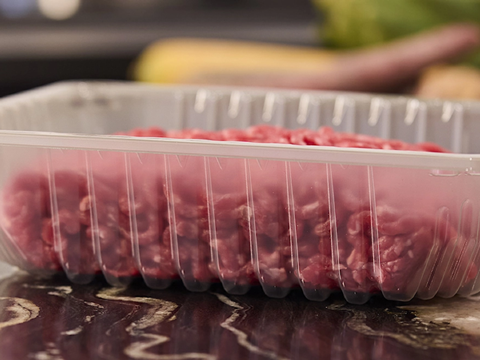
Faerch and Norfersk have launched meat trays containing 70% food-grade, tray-to-tray recycled PET, anticipating a dedicated material loop for thermoformed food packaging.
With a verified emission factor of 0.452kg CO2 equivalent, CIRPET+ – Faerch’s tray-to-tray clear and coloured recycled PET – is said to unlock a 30% lower climate impact than bottle-derived PET and 80% lower than virgin PET.
The recyclate is set to help food producers address growing pressure to reduce packaging-related emissions without impacting food safety, shelf life, or efficiency.
Recycled PET supply has conventionally been sourced from bottle streams. As this recyclate is increasingly prioritized for closed-loop bottle recycling, CIRPET+ is expected to keep food-grade PET within a circular system dedicated to food trays.
Now, Faerch seeks to help Norfersk transition smoothly into circular trays that meet operational demand and pursue circularity.
“Since the launch, the transition has been very smooth from a production perspective,” says Anne Maren Krog Engeloug, product developer at Norfersk. “The trays have performed well on the line, helping to ensure a more stable operation. It’s a win for both production efficiency and the environment.”
“This launch with Norfersk shows what is possible when a food producer and a packaging partner commit to circularity together,” adds Mette Grotrian, sales director at Faerch Nordics. “With CIRPET+, we are helping bring food-grade, tray-to-tray recycled content to the meat aisle at scale, without asking producers to compromise on line efficiency or shelf performance.”
This is the latest step in an ongoing collaboration between Faerch and Norfersk. Back in 2020, the meat producer adopted Faerch’s Ultra Low Stacking solution.
The move was said to have reduced the gap between stacked trays to 1.5mm and pallet requirements by up to 67% – helping to cut down on delivery miles, CO2 emissions, and excess transit packaging.
Faerch went on to implement at least 40% tray-to-tray, kerbside recycled PET into CPET ready meal trays in 2024. The development was said to achieve a 57% reduction in carbon footprint compared to virgin PET, and the recipe is compatible with up to 70% post-consumer recycled content, including mixed-colour bottle flakes.
Since then, Hilton Foods and Tesco have piloted Klöckner Pentaplast’s 100% rPET food trays made from recovered tray material to package the retailer’s own-brand minced beef. The trays were sealed with the kp FlexiLid barrier film, which contains 30% post-consumer recycled content.
If you liked this story, you might also enjoy:
The ultimate guide to packaging innovation in 2026
Packaging and Packaging Waste Regulation: what to know in 2026
Everything you need to know about global packaging sustainability regulation












No comments yet