
“Industry-first” common protocol for evaluating film packaging recyclability in Japan
The artience Group, through its packaging solutions subsidiary Toyo Ink Co., Ltd., and DIC Corporation has announced the development of
The artience Group, through its packaging solutions subsidiary Toyo Ink Co., Ltd., and DIC Corporation has announced the development of

The operational impacts of PPWR and how it shapes packaging decisions across the product lifecycle.
ACG Packaging Materials has released RecycloPod PP Ultra, a polypropylene-based blister packaging system that offers recyclability and barrier protection

Responding to tightening global packaging regulations and the recognition of coatings as a ‘critical enabler’ of circular packaging design, Paramelt has introduced its Aquavate™ Bio water‑based, biodegradable coating platform designed to support recyclable and compostable packaging solutions at industrial scale. The company tells us more in this Spotlight.
The Aquavate™ Bio portfolio offers a range of synthetic, bio-based, recyclable and biodegradable polymer dispersions. These dispersions can be used individually or in combinations as blends or multi-layer solutions, allowing performance optimization in the replacement of traditional synthetic paper coatings. The focus is on functionality first: delivering barrier properties and heat‑sealability while maintaining compatibility with existing coating and converting equipment.
The platform’s capabilities were demonstrated earlier this year through a joint development with UPM Specialty Materials, where Aquavate™ Bio was combined with UPM’s barrier base papers to create a recyclable, paper‑based food packaging concept for bakery, fast food and convenience applications (said to be certified recyclable according to Cepi/4evergreen v.2). The solution achieved strong grease resistance and heat sealability at coating weights of only 4 - 6 g/m², a benchmark that is challenging even for conventional fossil‑based coatings, while also offering improved end‑of‑life performance.
At the core of Aquavate™ Bio is a unique water‑based dispersion technology. The dispersions are formulated from biodegradable components with a high share of bio‑based content. Selected grades offer home, industrial and marine degradability, enabling packaging structures that are compatible with both recycling streams and organic waste pathways depending on local infrastructure.
According to Paramelt, one of the key advantages of the Aquavate™ Bio platform is practical scalability.
“The market needs more than lab scale concepts,” the company explains. “Converters and brands want solutions that can be implemented today, using existing coating processes and standard converting lines, without major investment or complexity.”
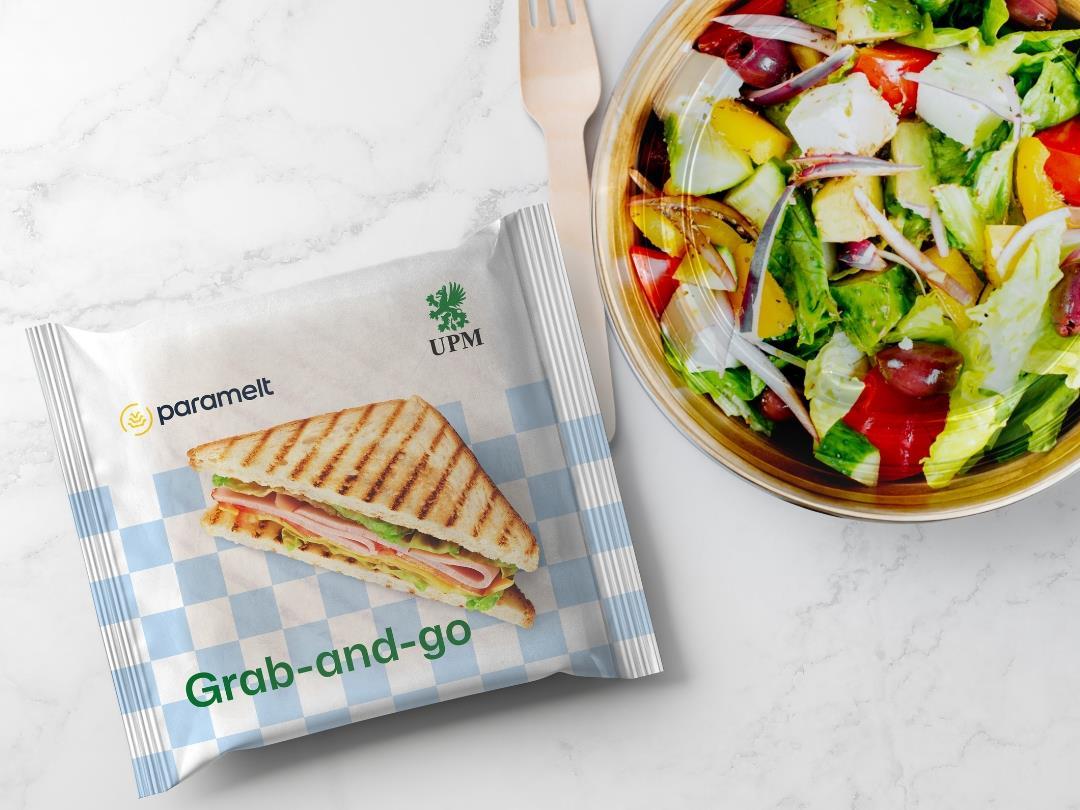
While paper‑based packaging continues to replace plastics in many segments, performance requirements, particularly for greasy or moisture‑sensitive food, remain a major hurdle. Coatings that deliver robust functionality without compromising recyclability or compostability are therefore becoming a strategic differentiator.
Aquavate™ Bio is designed to address this gap. The range encompasses heat‑seal coatings, barrier layers and functional surface treatments, allowing converters to tailor solutions according to application needs. Importantly, Paramelt highlights that coat weight reduction is a key packaging design parameter, supporting both material efficiency and downstream recycling performance.
The collaboration with UPM illustrates how such coating platforms can unlock the full potential of fiber‑based packaging. By pairing engineered base papers with advanced bio‑based coatings, the partners demonstrated that high performance and circularity do not need to be mutually exclusive.
Looking ahead, Paramelt sees Aquavate™ Bio as a cornerstone of its broader sustainability strategy. The company is actively expanding the platform to cover additional use cases within food, consumer goods and industrial packaging, with a clear emphasis on regulatory alignment and real‑world feasibility.
As packaging evolves, driven by design for circularity, solutions like Aquavate™ Bio underline the growing role of coatings as enablers of circular packaging - Paramelt positions itself at this intersection of material science, process efficiency and sustainable packaging design.
This content was sponsored by Paramelt.


In this edition of The Spotlight, Markem-Imaje examines how 2D coding is redefining the role of flexible packaging and


The material that consumer and industrial (C&I) applications rely on just got a sustainability upgrade. DuPont talks us


Utilizing vacuum aluminizing and laser-writing technologies, Shunho Creative (a sub-brand of Shanghai Shunho International) has developed a plastic-

Seeking to meet the challenges of the climate crisis and regulatory changes, Smurfit Westrock is investing in its manufacturing network,

ATS-Tanner’s banding solutions aim to reduce packaging waste, provide a practical alternative to plastic and improve recyclability. In
In this edition of The Spotlight, Markem-Imaje examines how 2D coding is redefining the role of flexible packaging and
The material that consumer and industrial (C&I) applications rely on just got a sustainability upgrade. DuPont talks us