




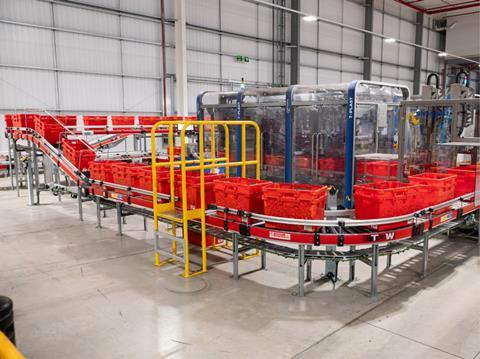
Ocado has automated the final packaging handling step for grocery deliveries with its Automated Frame Loader (AFL), powered by Beckhoff technology. The company enables customer fulfilment for Ocado and Morrisons in the UK, Kroger in the U.S., Sobeys in Canada, and other retailers worldwide.
Ocado’s customer fulfilment centres (CFCs) are designed around one simple promise: to deliver every order within a one-hour slot. To maintain its 99% on-time dispatch rate and order accuracy, every process must run smoothly, from item picking to van loading.
The process of lifting heavy totes filled with groceries onto van frames for delivery remained manual until the introduction of the AFL. Each tote can weigh up to 20 kilograms, and every van frame holds four stacks of boxes.
According to Beckhoff, the AFL can load up to 350 totes per hour onto van frames, ensuring consistent accuracy and speed. The machine operates continuously, up to 20 hours a day, and dynamically scales throughput in response to order volumes.
Each AFL is equipped with a Beckhoff C6017 Industrial PC that coordinates all AFL motion, handling control and functional safety. It communicates with Beckhoff TwinSAFE I/O terminals — safety-rated components that centralize safety control from multiple sensors and devices across the AFL.
Beckhoff adds that the IPC and EtherCAT-based I/O architecture allows for ‘seamless integration’ of vision systems, which can help locate tote positions on imperfect frames. The TwinCAT software platform enables integration into CI/CD pipelines and allows validated operating system updates, PLC code, and safety logic changes to be administered centrally and automatically rolled out to globally deployed assets.
While Ocado’s cybersecurity tools are developed internally, Beckhoff says its open architecture ensures compatibility with Ocado’s monitoring and traceability systems, enabling secure data exchange between the AFL and the wider warehouse management network.
Looking ahead, Ocado plans to expand its automation technology beyond grocery, applying the same innovations to pharmaceuticals and clothing, among other product areas.
In other automation news, last year Tetra Pak launched its Automation and Digitalization portfolio, Tetra Pak Factory OS, a suite of ‘modular, open and scalable’ smart factory technologies designed for food and beverage production, aiming to ‘lay the foundation’ for AI-ready factories. The portfolio features a data integration platform that connects equipment and systems throughout the factory, to unify data into one real-time view.
More recently, BBS Automation released the second generation of its automation system for producing Petri dishes, HEKUdish next Gen, said to combine quality, speed, and flexibility. The dishes are handled with contact-sensitive grippers and conveyor elements to prevent scratches or microscopic damage, and are packaged in vacuum-sealed tube bags.
If you liked this story, you might also enjoy:
The ultimate guide to packaging innovation in 2026
Packaging and Packaging Waste Regulation: what to know in 2026
Everything you need to know about global packaging sustainability regulation








No comments yet