

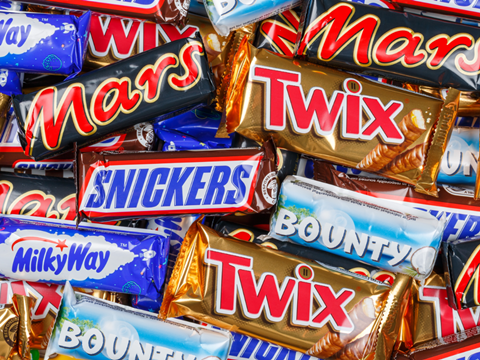
In its latest sustainability report, Mars claims that over 67% of its consumer-facing packaging is designed to be reusable, recyclable or compostable – and reiterates industry-wide challenges with infrastructural limitations and access to food-safe recyclate.
As of the report’s publication, Mars states that 67.6% of consumer-facing packaging is currently designed to be reusable, recyclable or compostable.
Specific developments include a new, mono-material pouch for its Whiskas wet pet food, developed alongside suppliers and recycling partners to maintain product quality and safety while increasing recyclability.
Through its collaboration with the Georgia Tech Research Corporation, Mars has also investigated the use of chitin-based coatings with compostable films – aiming to assess their durability and performance in demanding packaging applications. The results were published in the peer-reviewed journal ACS Applied Polymer Materials.
Furthermore, the company claims to have incorporated 18,721 tons of recycled content into its packaging – equivalent to 9.2% of the weight of post-consumer-recycled resin in its portfolio. The move is anticipated to help strengthen market demand for recycled content.
Mars states that it now sells multiple products in 100% rPET packaging, such as its M&M’s, Skittles and Starburst club jars (excluding caps) in the United States; its Tata and PimPom jars in China; and part of its MasterFoods squeezy sauce bottle portfolio in Australia.
According to its website, though, the company’s ‘highest priority’ is to ‘significantly reduce’ its use of virgin plastic, eliminate ‘problematic and unnecessary’ packaging materials from its portfolio, and prevent its waste products from contaminating recycling streams or the natural environment.
In 2025, Mars reports a 5.9% reduction in virgin plastic compared to a 2019 baseline. Last year’s efforts include redesigning the packaging for its Mixed Minis chocolate selection in India, transitioning from a multi-material pouch to a tin canister.
Mars has also replaced polystyrene trays with recyclable cardboard in its Snickers gift box, and has conducted in-market trials with kerbside recyclable paper flow wraps for its KIND Snacks product in the United States.
So, too, does Mars underline ‘significant progress’ in achieving a deforestation- and conversion-free supply chain for its pulp and paper-based packaging, claiming to have achieved the ambition for its cocoa and soy supplies.
Previously, Mars expressed doubts that it would achieve its sustainability goals for 2025. It claimed to be “making good progress” in its 2023 Sustainable in a Generation Report, with 61% of its portfolio already designed for recycling, reuse or compostability compared to its 100% target.
Yet the company warned that industry-level design and infrastructural changes were “taking longer than we anticipated when we signed the Ellen MacArthur Foundation Global Commitments” – adding that these “fundamental issues” could not be solved by businesses alone.
It expresses a similar sentiment in its latest report: “Improving the sustainability of packaging requires system-wide change. Progress depends not only on packaging design and materials innovation, but the ability of these packs to be integrated into real-world collection and recycling systems upon its end of life.
“The pace of progress remains closely linked to the readiness of these systems and the availability of food-safe recycled materials in many markets. We continue to work with industry partners, governments and NGOs to strengthen recycling systems and help accelerate the transition toward a more circular packaging economy.”
Mars emphasizes that it is redesigning its portfolio to align with recycling infrastructure “that either exists today or will likely exist in the near future”, alongside its ongoing efforts to increase recycled content and reduce its packaging overall.
The company featured alongside other top FMCG signatories of the Ellen MacArthur Global Commitment in our recent report. There we suggested that Mars’ share of recyclable, reusable or compostable packaging was significantly lower than its peers, and that it had undergone the least sustainability progress compared to other FMCGs; yet we also highlighted its growth in virgin plastic use and paper packaging alternatives.
Yet Mars is also continuing its work with the Ellen MacArthur Foundation and other FMCG brands to unlock over €50 million in multi-year investment for collection and recycling systems in Recife, Brazil. The partners plan to explore the feasibility of a new approach to packaging collection and recycling systems, hoping that it could inform national policy and become a model for similar cities.
If you liked this story, you might also enjoy:
The ultimate guide to packaging innovation in 2026
Packaging and Packaging Waste Regulation: what to know in 2026
Everything you need to know about global packaging sustainability regulation












No comments yet