
Pulpex opens first commercial facility for paper bottle manufacturing
Pulpex has opened its first commercial manufacturing facility for fibre bottles, scaling up from pilot-scale production with an initial
Pulpex has opened its first commercial manufacturing facility for fibre bottles, scaling up from pilot-scale production with an initial

The New European Reuse Alliance (New ERA) is spearheading an industry-led initiative that seeks to develop shared principles, a
The artience Group, through its packaging solutions subsidiary Toyo Ink Co., Ltd., and DIC Corporation has announced the development of

Advent calendars are a well-established Christmas tradition, but are they inherently wasteful – or are they adapting to a more sustainability-conscious market? We dive deeper into the format’s recent developments to learn more.
Materials
In theory, advent calendars should be recyclable. Business Waste reports that a conventional calendar contains 21.61g of PET, 7g of paper, and 3.22g of aluminium; if each component – the cardboard box, interior foil, and a mono-material plastic tray – can be cleaned and separated into its respective waste stream, they remain within their material loops.
It isn’t always so simple in practice. As Iiro Numminen, packaging designer at Metsä Board, tells Packaging Europe: “Many advent calendars use both paperboard and plastic, which makes recycling more difficult.”
“Traditional calendars often use mixed materials (plastic trays, foils, laminates) that are difficult to recycle,” adds Roberts Vasilevskis, general manager of Van Genechten Packaging’s Kvadra Pak production site in Riga and member of the Van Genechten Packaging Group.
To resolve the issue, some manufacturers are turning towards mono-paper redesigns – and several of them were commended under this year’s European Carton Excellence Awards. In Vasilevskis’ view, “moving towards mono-material construction (single-use board) simplifies recycling.”
The Lumene 24 Nordic Beauty Secrets calendar – manufactured with MetsäBoard Prime FBB Bright and MetsäBoard Pro FBB Bright folding boxboards in collaboration with Van Genechten Packaging – is FSC-certified and, as Numminen elaborates, “can be recycled in the paperboard collection after Christmas.”
Mondelēz’s Milka calendar, developed by MM Packaging Polska using cartonboard from Stora Enso, reportedly uses a water-based varnish to balance visual appeal with full recyclability. Similarly, Forsman Tee’s calendar – developed alongside Grano and MM Board & Paper – uses 245 g/m² ALASKA BRIGHT, which is said to be mono-material and recyclable.
Le Petit Vapoteur also upfronts that its beauty calendar features an outer protective sleeve and inner cartons made from virgin fibre cartonboard, and is packed in 100% cartonboard transport packaging. Each component is said to be recyclable.
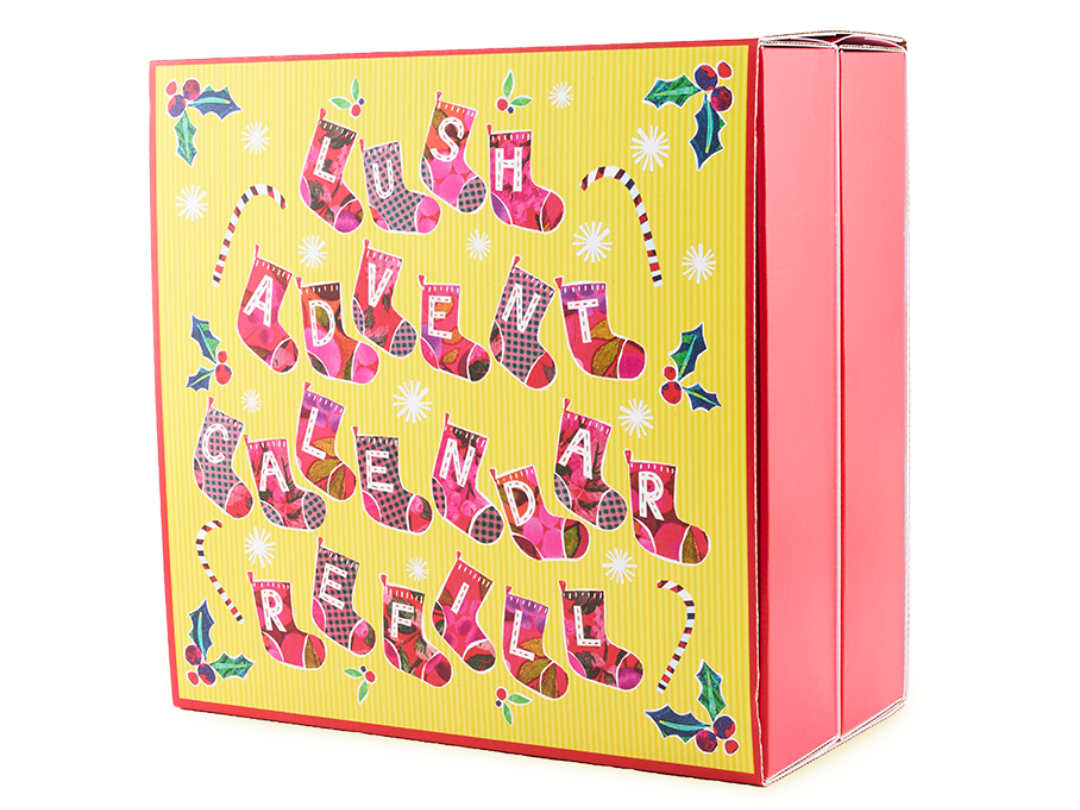
Beyond the Pro Carton sphere, the calendar unveiled by Lush this year targets recyclability, but not before reusability. The pack comprises a box made from 100% recycled card and protective Eco-Pops made from puffed non-GM cornstarch, certified as degradable according to the EN13432 standard.
Recycled content factors into the design, too. Lush completes the calendar with a ribbon made from recycled plastic bottles, although it is arguable that this approach interrupts the bottle-to-bottle recycling loop and ‘downcycles’ valuable recyclate.
John Lewis takes a similar approach. Its fill-your-own advent calendar is designed to be reused in future years, but it reportedly consists of 40% handmade paper, 20% kraft paper, and 40% flock – and it is unclear whether the latter can be removed to recycle the paper content at end-of-life.

Shape and function
“Improving structural design can enhance usability, reduce packaging waste, and make the daily reveal more engaging,” Vasilevskis tells us. Chocolate calendars have started experimenting with a similar mindset; the award-winning Milka calendar unfolds into a Christmas tree shape, with the ‘doors’ turning into ornaments to be hung up after use – a design hoped to appeal to children.
Yet the calendar format is evolving to package larger, heavier objects for older consumers. Research by Ipsos indicates that, while 84% of UK consumers buy calendars containing chocolates, beauty products take the second spot (15%), with 40% of respondents in the 18-34 age bracket claiming to have bought these alternatives.
“One of the main elements in luxurious packaging is to stand out,” Numminen told us; and previous research indicates that 55% of consumers would switch brands in response to packaging design innovations.
“In some cases, this is achieved at the cost of sustainability,” Numminen continued. “One example of this is that [calendars] can be unnecessarily large, and they can also be complex to manufacture.”
Redesigns to support the extra weight and size of non-chocolate products have become a necessity. To name an example, Beer52’s craft beer calendar, developed alongside Smurfit Westrock, measures at 45 cm x 46 cm x 18 cm; compare this to a Lindt advent calendar, which measures at 34.4 cm x 27.3 ckm x 3.4 cm. (Smurfit Westrock emphasizes that the Beer52 calendar was designed to minimize components and prioritize the ease and speed of assembly for mass production.)
The general upscaling of calendars has sparked concerns about material consumption. The Nordic Beauty Secrets calendar’s approach is to optimize space and avoid excess: “We wanted to pack the product as tight as possible to save space in transportation but not sacrifice shelf appeal or opening experience,” Numminen tells us.
Taking inspiration from the Adventskrans, or Advent Wreath, the calendar layers smaller boxes into a three-dimensional, “puzzle-like” ‘flower’ shape. ”This creates dimensionality, overhanging edges, and a sense of discovery,” Vasilevskis tells us.
Furthermore, the calendar is designed to maximize product-to-pack ratio, avoid empty space, and keep both packaging waste and carbon emissions to a minimum.
“Many calendars rely on uniform compartments, which often waste space and don’t fit products securely,” Vasilevskis continues. ”Improving structural design can enhance usability, reduce packaging waste, and make the daily reveal more engaging.”
“Despite the unique structure, the calendar is easy to manufacture,” Numminen explains. “We found nice way to produce only four different carton structures to secure all twenty-four products.
“These four structures are multiplied six times to create the stunning outlook. This also makes the conversion of the cartons more cost-efficient when you only need to convert four different structures instead of twenty-four.”
Waste reduction
Another approach is to develop reusable solutions. As Vasilevskis tells us, “calendars can also integrate modular or reusable elements, encouraging consumers to repurpose them after the season.”
Lush sells refills for empty calendars for previous years, incentivizing consumers to buy by including exclusive beauty products. The refill box is apparently made from 100% recycled board fibres.
“Please reuse, regift or recycle again at the end of its life,” the company’s site reads. “A box is for life, not just for Christmas.”
John Lewis offers a similar concept. According to its press release, the calendar “is housed in a fully recyclable box with clever compartments, allowing it to be reused to create your own bespoke advent calendar in the future.”
Forsman Tea’s calendar looks beyond the festive season. Its inner tea boxes are designed for reuse outside the advent calendar concept, thus extending the product’s lifespan.
However, the rise of non-edible products in a calendar raises questions about unnecessary packaging waste. While chocolates are generally unwrapped beneath the foil layer, liquid products like skincare sets and perfumes must inevitably come in bottles, dispensers, tubs, and other containers – all of which must be thrown away once the product is empty.
For the beauty sector, in particular, this is a challenge. According to the British Beauty Council, 95% of cosmetics packaging is discarded, but only 14% ever makes it to a recycling plant, and only 9% is actually recycled.
Does this mean that new calendar formats are inherently wasteful? Everyday Plastic’s founder and director Chris Webb told the Guardian that he doesn’t blame consumers for wanting to participate in a holiday tradition, but questions the “superfluous consumerism” that advent calendars can help promote.
“These luxury Advent calendars are a microcosm of a bigger problem, a system that keeps producing more and more stuff we don’t need and probably can’t afford,” he says.
Especially if the products aren’t limited-edition and could feasibly be bought as standalone gifts, there is an argument to be made that the advent calendar format is just a novelty, with the box and tray adding unnecessary waste.
Journalist and author Sali Hughes asks the Guardian’s readers to consider whether they would purchase “at least five” of an advent calendar’s products at full price. If not, she urges them to view the calendar as “something pretty ephemeral that will, if it’s even been designed responsibly in the first place, just go into recycling after Christmas.”
If you liked this story, you might also enjoy:
The ultimate guide to the Packaging and Packaging Waste Regulation in 2025
How are the top brands progressing on packaging sustainability?
Everything you need to know about global packaging sustainability regulation in 2025
The key to increasing the use of reusable packaging in supermarkets


In this edition of The Spotlight, Markem-Imaje examines how 2D coding is redefining the role of flexible packaging and


The material that consumer and industrial (C&I) applications rely on just got a sustainability upgrade. DuPont talks us


Utilizing vacuum aluminizing and laser-writing technologies, Shunho Creative (a sub-brand of Shanghai Shunho International) has developed a plastic-

Seeking to meet the challenges of the climate crisis and regulatory changes, Smurfit Westrock is investing in its manufacturing network,

ATS-Tanner’s banding solutions aim to reduce packaging waste, provide a practical alternative to plastic and improve recyclability. In

Pulpex has opened its first commercial manufacturing facility for fibre bottles, scaling up from pilot-scale production with an initial

The New European Reuse Alliance (New ERA) is spearheading an industry-led initiative that seeks to develop shared principles, a

The artience Group, through its packaging solutions subsidiary Toyo Ink Co., Ltd., and DIC Corporation has announced the development of

ACG Packaging Materials has released RecycloPod PP Ultra, a polypropylene-based blister packaging system that offers recyclability and barrier protection