




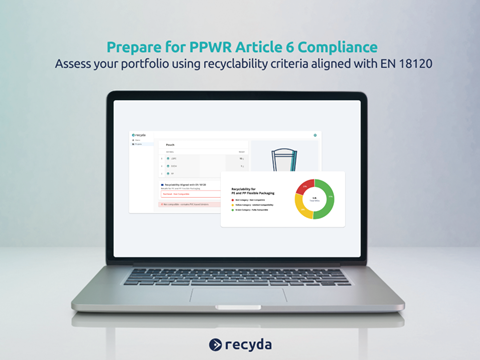
In this edition of the Spotlight, Recyda explains why companies should start preparing now for the PPWR’s Article 6 recyclability requirements and what steps they can take to ensure readiness.
Throughout 2025 and 2026, companies preparing for the EU’s Packaging and Packaging Waste Regulation (PPWR) have largely been focused on the initial August 12, 2026 deadline. The initial requirements — including Article 5 (Substances of Concern) and Article 11 (reusable packaging) — have required significant groundwork, from consolidating extensive Technical Documentation to preparing Declarations of Conformity.
With the PPWR now in force, companies are turning their attention to what comes next. One of the most significant areas to prepare for is Article 6, which introduces new requirements around packaging recyclability.
Under PPWR Article 6, from January 1, 2030, all packaging placed on the EU market must be recyclable by design. Packaging will be graded based on recyclability performance and only packaging that aligns with Grades A, B, and C will be considered compliant and can remain on the market.
The challenge for companies is that the detailed DfR criteria underpinning these grades have not yet been finalized. The European Commission is to adopt the relevant delegated acts by 2028, meaning companies do not yet have the complete technical criteria they will ultimately need to meet.
But waiting for the final criteria to be published could leave companies with a very narrow window to act. Packaging redesign is rarely an overnight process. It can involve assessing current formats, identifying potential alternatives, testing and validating new designs, qualifying suppliers, updating specifications, and ultimately rolling changes out across an entire packaging portfolio.
The practical way forward
Not knowing the final DfR criteria shouldn’t prevent companies from taking action today. In fact, it creates a strong case for conducting a risk assessment now.
The goal at this stage is not to predict the final recyclability grade of every packaging format. Instead, companies should identify the packaging most likely to face restrictions under the future requirements and prioritize those formats for further assessment and, where necessary, redesign.
But what criteria can companies use to identify high-risk packaging today?
A useful starting point is the new EN 18120:2026 series, a set of European Standards developed by CEN to provide a common framework for evaluating the design-for-recycling of plastic packaging.
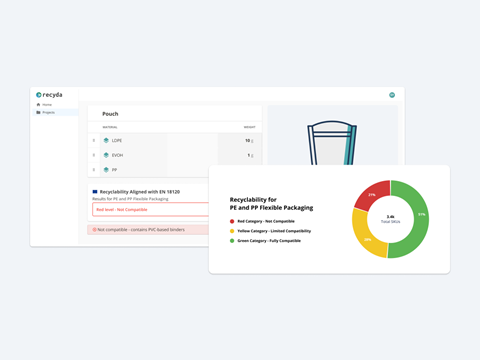
These standards provide guidelines to classify your packaging portfolio into distinct recyclability categories:
● Fully compatible
● Limited compatibility
● Not compatible
This classification provides companies with a practical starting point. Packaging categorized as “Not compatible” is at the highest risk and are ideal candidates for a redesign.
Want to know exactly what you can do today?
Download our guide for a practical blueprint of actions to start preparing for PPWR Article 6, including how to apply the EN 18120 guidelines to your portfolio to identify and prioritize high-risk packaging.
Using digital solutions to prepare for PPWR
Preparing for PPWR compliance can be both time-consuming and resource-intensive. Teams need to maintain data on every packaging unit, keep track of compliance, assess recyclability and risk.
They need to interpret complex standards such as EN 18120 and ensure they have the right information to perform accurate recyclability assessments.
Recyda helps you automate much of this process.
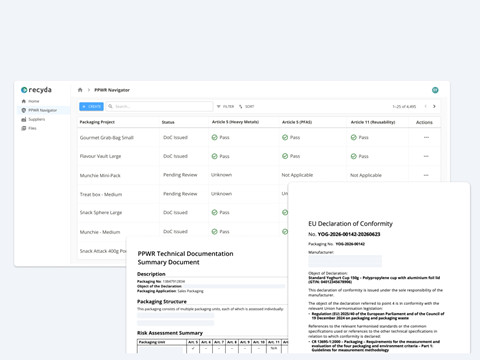
For Articles 5 and 11, Recyda helps you manage your packaging data to use as your supporting Technical Documentation and generate Declarations of Conformity directly from the platform.
For PPWR article 6, Recyda helps assess your packaging using recyclability criteria aligned with the EN 18120 standards. The result is a clear categorization of your portfolio, so that you can identify the high-risk packaging, understand the reasons driving their low score and prioritize their redesign.
Instead of managing compliance through disconnected spreadsheets and manual assessments, teams can create a structured, data-driven approach to PPWR compliance — from collecting the right data to identifying where action is needed most.
Ready to see how Recyda can help? Talk to a Recyda expert today to see how a structured, digital approach can simplify PPWR compliance and help you prepare for what’s ahead.
This content was sponsored by Recyda.