
Innovia Films reveals new high-barrier metallized BOPP film
Innovia Films has introduced Propafilm CHBM, an ultra-high barrier metallized BOPP film said to provide ‘exceptional’ product protection and
Innovia Films has introduced Propafilm CHBM, an ultra-high barrier metallized BOPP film said to provide ‘exceptional’ product protection and

Kraft Natural Cheese has introduced its Pocket Parm miniature bottle format for its grated cheese, designed to clip onto a
Australian Vintage's Poco Vino offers wine in 178 ml single-serve bottles for easier transportation, lower-waste sampling,

First introduced in 1876, Heinz’ tomato ketchup bottle has become instantly recognisable on shelf due to its clear colour and upside-down design – but it has been through many changes of shape, material and cap to get to where it is today. In this installment of our Iconic Packs series, we take a look at the history of the bottle, from the glass bottles of the late 18th and early 19th centuries to the 1980s squeezable bottle and introduction of the Balaton cap in 2023, replacing non-recyclable flip top caps.
The Heinz Tomato Ketchup originally appeared on US shelves in 1876 as ‘Catsup’, in a clear glass bottle. The clear colour was chosen to showcase the ‘purity’ of the ingredients, in contrast to competitor brands who tended to use brown bottles. In 1890, the glass octagonal bottle was patented after its introduction the year before, with the eight-sided shape designed to prevent counterfeiting and enhance brand recognition. An article by The Packaging Company notes that the curved neck encouraged the ketchup to flow out smoothly, while the narrow mouth minimized the amount of ketchup exposed to air, preventing it from turning brown.
In 1906, the Heinz narrow-neck glass bottle with a tapered design and ‘57 Varieties’ label was introduced, featuring a screw cap instead of a cork stopper. In 1970, Heinz launched the ‘Keg O’ Ketchup,’ a large 32-ounce glass bottle that kept the octagonal design while allowing for bulk dispensing. Due to its wide base to prevent tipping, and larger portion size, it was often used in diners and family restaurants across America.
The ‘squeezable’ bottle
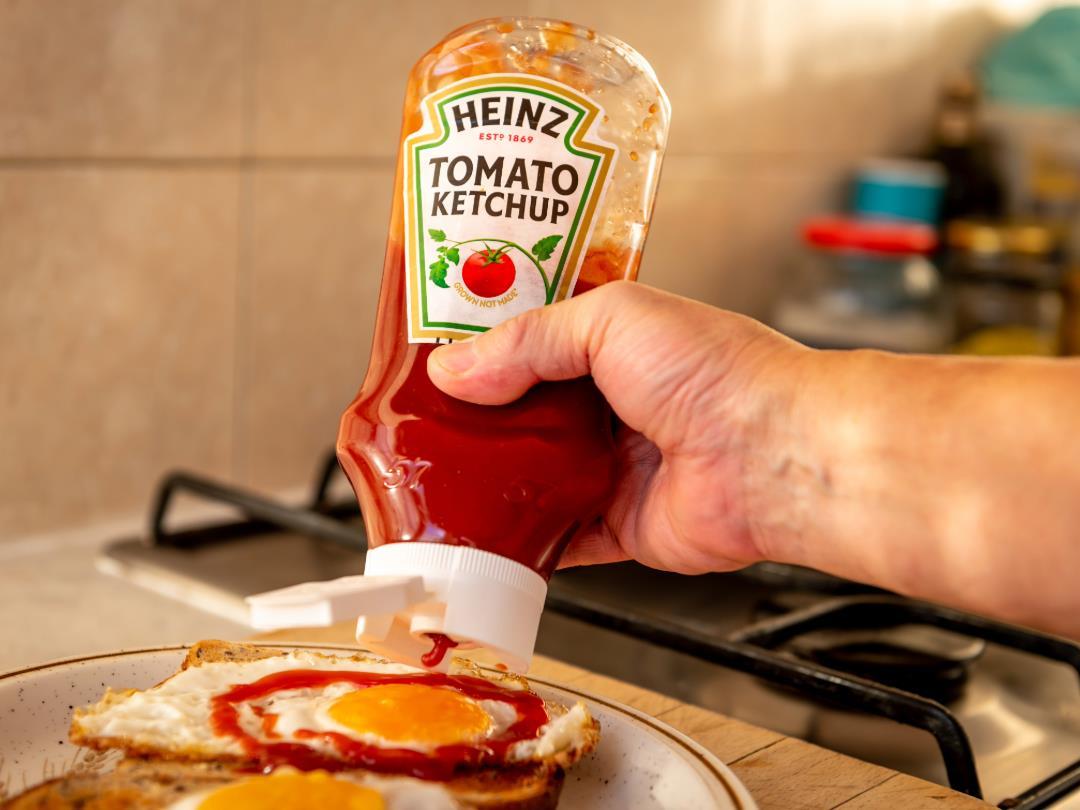
1983 saw the launch of the ‘squeezeable’ plastic bottle, which The Packaging Company says became so popular that Heinz “eventually stopped production of their glass bottle - until 2011, when they released a limited-edition bottle, complete with a version of their original label.”
In an article on the evolution of Heinz Ketchup, GBO states that while the new design was convenient, the complexity of multiple plastic layers was due to present recycling challenges. In 2002, Heinz launched the ‘upside-down bottle’ to address gravity-related issues. The design included a silicone dome valve, a mechanism that allowed bottles to be stored upside down, aiming to eliminate ketchup wastage.
GBO adds that in 2014, the company introduced bottles made from PET and plant-based resources, with the lid’s lip deepened to improve accessibility. It’s also worth mentioning the 2012 PlantBottle, highlighted by The Packaging Company - reportedly made from up to 30% renewable plant material, designed to reduce environmental impact and 100% recyclable.
More recently, Kraft Heinz introduced the Balaton cap in 2023, designed to replace non-recyclable flip-top caps. The mono-material cap aims to ensure controlled dosing, consistency and ease of recycling.
How user experience re-designed the bottle
Over the years, the design of the Heinz Ketchup bottle seems to have evolved in response to user experience, whether it’s the introduction of the squeezable bottle or the launch of the upside-down bottle. UX Design Institute expanded on this in 2019, commenting that “as many of us have experienced, getting ketchup out of a glass bottle is definitely one way to give the biceps a workout. Step one is to turn the bottle upside down and hold it in one hand. Step two is to vigorously bang the end of it with the other hand to get the ketchup into motion and out onto the plate.”
The Institute also notes the company’s introduction of the EZ Squirt bottle, designed to be accessible to children, following the realisation that “the product’s biggest consumers (kids) did not have direct access to it”. The company aimed to package its ketchup in a bottle that children could control themselves.
The EZ Squirt bottle was launched, made out of soft plastic with a conical nozzle. It was much lighter to hold and the ketchup required much less effort to come out. UX Design Institute emphasizes that Heinz “didn’t redesign the bottle just for the hell of it” - it was a decision made based on data gathered during user research.
Looking ahead
From the initial glass bottle and octagonal design to the introduction of larger sizes, plastic bottle variants and plant-based materials, the Heinz ketchup bottle has certainly been through a lot of changes since its inception. Who knows how its design will progress next? We’ll definitely be keeping an eye on it…
If you liked this story, you might also enjoy:
The ‘complex reality’ of reusable packaging in Europe
Single-use packaging versus reusable packaging: Which is more sustainable?
The ultimate guide to global packaging sustainability regulation

PPWR is a data challenge. In this Spotlight, we find out how Centric Software® tackles the challenge through a connected

In this Spotlight, Plastipak discusses the opening of its PET material centre in Verbania, Italy. Home to pakPET™ Single Pellet

In the latest edition of the Spotlight, Matthew Wright, Founder and CEO of FOREST-PKG, shares why finding the right

Duynie has decades of experience in developing applications for side-stream potato starch. With Novinexx CPB, the company is applying


In this edition of The Spotlight, Markem-Imaje examines how 2D coding is redefining the role of flexible packaging and


The material that consumer and industrial (C&I) applications rely on just got a sustainability upgrade. DuPont talks us

Innovia Films has introduced Propafilm CHBM, an ultra-high barrier metallized BOPP film said to provide ‘exceptional’ product protection and

Kraft Natural Cheese has introduced its Pocket Parm miniature bottle format for its grated cheese, designed to clip onto a

Australian Vintage's Poco Vino offers wine in 178 ml single-serve bottles for easier transportation, lower-waste sampling,

UPM is working with Ingredion and Paramelt to research the use of starch-based barrier technologies for recyclable paper food