



Traceless has announced the first industrial production facility for its bio-based, home-compostable natural polymer technology, aiming to end dependence on fossil raw materials and build a circular bioeconomy in Europe.
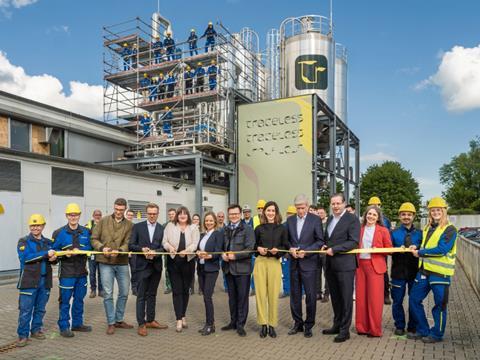
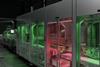
The company has opened its first large-scale production facility in Hamburg, Germany, where plant-based residues from the agricultural industry will be processed into a material that can be used as a natural plastic substitute. Traceless says its patented technology relies on a special extraction process that utilizes natural polymers from plant-based industry residues without modifying their natural chemical structure, resulting in bio-based and home-compostable granulates.
Traceless states that the production process is resource-efficient, enables local supply chains and reduces CO2 emissions by 91% during production and disposal compared to conventional plastics, according to the company’s Life Cycle Assessment (LCA).
Apparently, the material’s thermoplastic properties allow for further processing using standard industrial technologies, enabling the material to replace plastics in applications where technical recycling is difficult or where products easily end up in the environment, such as in single-use items, packaging, paper coatings or adhesives.
With a capacity of approximately 3,000 tonnes of Traceless material per year, the facility is due to serve customers including packaging manufacturer Mondi, e-commerce company OTTO and distribution partner Biesterfeld. All central areas of the plant have been successfully commissioned and production will be increased in the coming months.
The new plant was funded with €5,128,401 from the Environmental Innovation Programme of the Federal Ministry for the Environment, Climate Action, Nature Conservation and Nuclear Safety. The company’s pilot plant which has been in operation in Buchholz i.d.N. since 2022 is also set to be relocated to the site. Traceless adds that it is already planning the construction of a larger industrial plant to expand production capacity in the future.
Attending the plant’s opening ceremony, Carsten Schneider, federal minister for the Environment, Climate Action, Nature Conservation and Nuclear Safety, commented: “This is the sort of idea we need for effective climate and environmental protection: an innovative biomaterial that requires no fossil fuels, is made from plant-based residues and is completely biodegradable solves several problems at once. It can replace conventional plastic and reduce CO2 emissions and water consumption. This technology helps combat plastic pollution, protects wildlife and makes us less dependent on fossil fuel imports from abroad.”
In related news, Metsä Group announced in February that the demo plant for its new Metsä LigO lignin product has started up in Äänekoski, Finland, said to have a nameplate capacity of two tonnes of a new type of lignin product per day. The company aims to ensure the functionality of the lignin product’s production process and its characteristics and suitability for the market.
More recently, Zerolys launched its Phyber biomaterial made from engineered plant fibres, used to create rigid packaging containers such as bottles, tubes and jars for consumer packaged goods (CPG) applications. The material is said to be biodegradable and designed to naturally break down after disposal.
If you liked this story, you might also enjoy:
The ultimate guide to packaging innovation in 2026
Packaging and Packaging Waste Regulation: what to know in 2026
Everything you need to know about global packaging sustainability regulation













No comments yet