





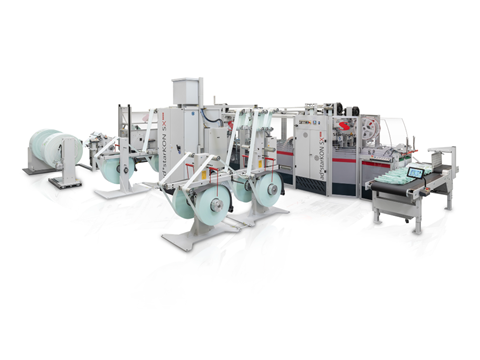
Starlinger is suing two companies for infringing three patents related to its conversion line for block bottom valve bags, with the Chinese Court ruling in its favour.
Starlinger holds three patents for its ad*starKON bag conversion line, which produces block bottom valve bags made of plastic tape fabric. It specifically owns the triangle bottom forming mechanism, or ‘wing opener’, used in the machine.
Last summer, Starlinger took legal action against Wenzhou Huazao Machinery Technology Co., Wenzhou Zhengong Machinery Co., and their customer, Zhejiang Liying Packaging Co. – alleging that the companies had infringed these patents.
While the decisions of the Chinese Court are not yet in force, a first result that Huazao and Zhengong have infringed Starlinger’s patents. The Chinese companies have been ordered to cease and desist manufacturing and selling the block bottom valve bag machines.
“The court decisions at first instance are an initial step to show that copying innovative technologies no longer goes unpunished in China,” said Starlinger CSO Harald Neumüller. “Although the decisions are not yet effective, there is no doubt that the original will ultimately win out over the copy.
“Technology leaders like us need to protect their innovations and defend their rights by all means. If companies try to copy our technologies, we are prepared and ready to take legal action against them and their customers.”
Other companies have taken legal action of their own. Mondelēz International has filed a lawsuit against Aldi over allegations that the retailer has infringed trademarked visual properties, and Danone has taken similar steps against Chobani over the slogan and packaging colours of its ready-to-drink cold brew coffee line.
ClientEarth has also filed a lawsuit against Nestlé Poland for ‘misleading’ recycled content and recyclability claims on its Nałęczowianka water bottles. On-pack statements ‘I am made from another bottle’ and ‘I am recyclable’ are thought to suggest that the bottle’s single-use plastic components will not cause environmental harm, which is considered a breach of consumer protection law.
If you liked this story, you might also enjoy:
The ‘complex reality’ of reusable packaging in Europe
Single-use packaging versus reusable packaging: Which is more sustainable?
The ultimate guide to global packaging sustainability regulation















No comments yet