




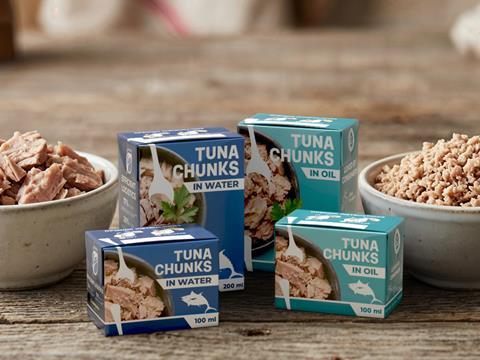
Tetra Pak has joined forces with Spanish seafood producer Jealsa to launch the industry’s first carton packaging for shelf table tuna.
The product was launched last month by Swedish retailer Axfood and will shortly be made available to food producers and brands worldwide.
Jealsa’s tuna brands Rianxeira, Mare Aperto and Robinson Crusoe are being packaged in Tetra Pak’s Tetra Recart solution, which aims to provide a cost-competitive, paper-based alternative to traditional metal cans.
From a sustainability point-of-view, Tetra Pak claims that the product has the smallest carbon footprint of any product in its category – “85% lower than steel cans and 83% lower than glass jars.” This reportedly equates to 21,000 tonnes less carbon dioxide for every 1 million cans.
In terms of functionality, Tetra Pak describes its new solution as “being easy to handle and having the ability to stack efficiently” and also hopes that its distinctive rectangular shape will create immediate shelf impact.
It is hoped that the pack’s large, flat surfaces will enable bolder branding and clearer storytelling, while the compact carton shape allows packages to fit tightly together, improving shelf efficiency and enabling more product per metre.
Packaging Europe put some additional questiions to Tetra Pak to learn more about this product - our questions and their answers are republished in their entirety here:
What percentage of the entire pack is paper? What are the other parts of the pack made from?
Tetra Recart is made primarily from paperboard, with up to 71% of the package made from paper. All our paperboard is FSC certified, sourced from responsibly managed, renewable forests. The remainder of the package consists of thin polymer and aluminium layers.
Is there a barrier? What is it made from?
Yes. The thin polymer and aluminium layers help protect food safety, freshness and shelf life.
How can it be recycled?
Our paper-based carton packages are recyclable where adequate collection, sorting and recycling infrastructures are in place, at scale. Tetra Recart is a paper-based composite that follows the same recycling principle as standard food and beverage cartons: the fibre is separated from the polymer–aluminium (PolyAl) layers through repulping in liquid packaging carton (LPC) recycling mills.
For consumers, the carton is easy to empty and flatten, ready for collection.
Tetra Pak and industry partners are continuing to invest in recycling infrastructure and sorting technology to strengthen carton recycling systems and increase recycling capacity over time.
If you liked this story, you might also enjoy:
The ultimate guide to packaging innovation in 2026
Packaging and Packaging Waste Regulation: what to know in 2026
Everything you need to know about global packaging sustainability regulation















No comments yet