


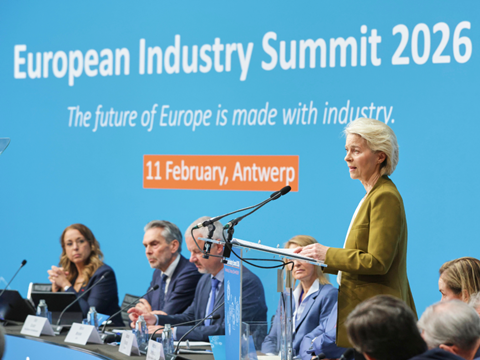
What is the current outlook for Europe’s manufacturing sectors – and what must be done to support them? In the aftermath of the European Industry Summit in Antwerp, we consult multiple industry players for their perspectives on promoting EU-made resources, lowering carbon and energy costs, establishing a circular economy, and more.
What’s the problem?
As reported by Cefic, Europe’s share of the global chemicals market has fallen to 13% – by contrast, China now accounts for 46% of global sales.
It attributes the chemical industry’s struggles to weak demand, increasing import pressure, and a 9.5% decline in capacity utilization. Europe is still a net exporter, Cefic says, but its trade surplus has not increased in correlation with global growth.
Cefic and Deloitte’s Monitoring Report declares that 83% of the EU’s competitiveness indicators have stagnated or deteriorated. It describes the EU as ‘fully import-dependent’ for over half of critical raw materials – and while its 12% use rate for circular materials is ‘well above the global average’, its success is compromised by the increasing closures of plastic recycling facilities.
Gas prices are thought to have risen by 13% in 2025 – a figure said to be 4.6 times higher than in the United States. Plant closures are also said to be six times higher than in 2022, with the cumulative capacity presently recorded at 37 Mt; this accounts for around 9% of European production capacity.
At the same time, Cefic suggests that annual announced investment capacity in innovations like circular plastics, electrification, and hydrogen feedstocks has decreased from 2.7 Mt in 2022 to 0.3 Mt year-to-date in 2025. The Monitoring Report records a 42% increase in EU businesses citing regulation as a barrier to investment over the past three years.
While the European chemical industry has apparently improved its energy efficiency by 40% since 1990, China is believed to be deploying clean power at five times the rate of the EU, and its clean energy capacity is said to be 2.4 times higher.
EU-level funding gaps, major oversubscription to the Innovation Fund, and a ‘complex and fragmented’ funding architecture are thought to slow the deployment of infrastructure, despite Member States providing 75% of public funding.
14% of the EU’s GDP is attributed to public procurement, but a lack of harmonized data and standards – including EU-wide green public procurement – is thought to have slowed demand for low-carbon and Made in Europe products.
According to the Monitoring Report, internal market barriers have created equivalent costs to tariffs of approximately 65% for goods and 100% for services.
“The sector is under severe stress and breaking,” argues Marco Mensink, director general at Cefic. “The rate of closures has doubled in a year, and even worse, annual investments are half and close to zero.
“On both sides, the speed is accelerating, not slowing. We need decisive action this year, with impact at factory floor level.”
“Europe is losing industrial capacity at a speed we have never seen before,” commented Markus Kamieth, CEO of BASF and president of Cefic. “This is not a temporary downturn – it is a structural competitiveness shift affecting all manufacturing sectors.
“If Europe wants to lead the clean transition, it must stop losing the industries that make that transition possible. We are not asking for protection from change; we are asking for competitive conditions to lead the change – and to safeguard high-quality jobs for European workers.”
How do we solve it?
As we previously reported, Plastics Europe argues that the EU must use Emissions Trading System (ETS) revenues to close the cost gap between energy and carbon, while INEOS suggests that the European Commission and Heads of State take action against cheap imports. The latter recommends that the carbon tax be suspended for five years while policymakers re-evaluate is purpose.
The European Container Glass Federation (FEVE) also calls for a package of Emergency Industrial Policy Measures that cut down on energy and carbon costs; align circular economy objectives with competitiveness goals – for example, by revisiting ‘overly prescriptive’ packaging minimization objectives; tackle unfair competition, including in carbon leakage protection; and introduce market incentives to drive consumer demand for safe, circular, and European-made products.
“The container glass sector is fully committed to delivering Europe’s climate and circular economy ambitions, and we are investing heavily in decarbonization technologies,” says Michel Giannuzzi, chairman of Verallia and president of FEVE. “But industry cannot deliver the transition alone.
“EU leaders must act now to bring energy and carbon costs down, accelerate grid deployment and simplify the regulatory framework. This is not for next year, not for next week, but for today.”
Even outside the chemical industry, various organizations have supported the Antwerp Declaration. Speira has called for a ‘comprehensive’ action plan as part of the European Strategic Agenda for 2024 to 2029; this should prioritize European competitiveness, clarify regulatory ‘incoherence’, and avoid over-reporting, among other improvements.
“Especially as [an] aluminium recycler, our processes enable us to avoid up to 95% of CO2 emissions compared to primary production, and our circular customer relationships allow us to keep this strategically important industrial metal as a valuable resource here in the loop,” says Speira CEO Einar Glonmes. “This capability is under serious threat from high energy prices and regulations that do not effectively prevent scrap from being exported to other regions of the world.”
Cepi argues that, despite production levels declining by up to 40% in 2025 compared to 2018, the pulp and paper industry has ‘emerged despite its own difficulties’. However, it raises such issues as ‘very fragmented’ collection and recycling processes across the bloc, insufficient market demand compared to fossil-based products, and over one hundred EU regulations complicating the industry’s growth.
“The European pulp and paper industry has already reduced its greenhouse gas emissions by more than 50% compared to 2005 levels,” said director general Jori Ringman. “But in the current context of high energy prices, low demand, high costs and an ongoing trade war, we have no choice but to ask the EU Heads of State assembled in Alden-Biesen to maintain free allocation levels and the eligible pulp and paper installations list of the 2021-2025 period and freeze any measures increasing carbon costs until 2030.”
Political tensions have been brewing in the wake of the Summit, an article from Euractiv suggests. President von der Leyen and nineteen like-minded EU leaders, many of them right-leaning, apparently came together in an informal working group before the event officially started.
In an X post, Italian Prime Minister Giorgia Meloni indicated that the working group would meet again before the next meeting on 19th March “to keep high attention on the issues of competitiveness and contribute to the definition of concrete objectives and precise deadlines.”
A European diplomat alleged that Spain had complained about the pre-meeting format, arguing that it hinders, rather than helps, the development of EU-wide solutions.
If you liked this story, you might also enjoy:
The ‘complex reality’ of reusable packaging in Europe
Single-use packaging versus reusable packaging: Which is more sustainable?
The ultimate guide to global packaging sustainability regulation














No comments yet