

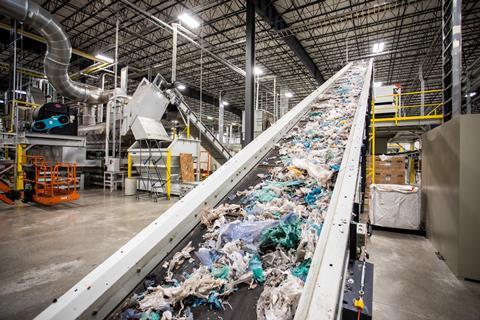
In a forthcoming report, Sorting and Recycling Flexible Packaging for a Circular Economy: Recommendations for Flexible Packaging Recycling in Europe (EU27+3), 2030–2035, CEFLEX demonstrates that flexible plastic packaging will need a diversification of recycling technologies to realize the switch towards quality recycling.
We spoke with Dana Mosora, Work Package Consultant, about the kinds of recycling technologies that will be needed as part of this roadmap, and the role CEFLEX is playing to help scale these.
PE: For those of our readers who are unfamiliar with the various technologies, could you please briefly explain which forms of advanced recycling are most relevant to the flexibles sector?
DM: For flexible packaging, advanced recycling is best understood as a group of technologies that can improve recyclate quality and help deal with material streams that are difficult to upgrade through conventional mechanical recycling alone.
There are three recycling processes: (1) mechanical recycling, (2) physical recycling and (3) chemical recycling.
- · Mechanical recycling can by complimented by a range of different recycling technologies for advanced decontamination. Examples include delamination, deinking and extraction. Which are required will depend on the quality of recycled polymer targeted.
- · Sorting technologies. Examples include, NIR, VIS. The new emerging techology is smart sorting, including digital watermarking or physical tagging.
- · To reach a specific recycled plastic grade you need to follow a recycling pathway. A recycling pathway is one or a combination of the recycling technologies with a combination of sorting steps before it, to get the required input for the recycling process.
The 2025 CEFLEX report ‘New Recycling Technologies – Advancing Circularity in Flexible Packaging’, written with input from a range of CEFLEX stakeholders, the University of Ghent and technology providers looks at technologies that address some of the main barriers in flexible packaging recycling: inks, adhesives, additives, multi-material structures and the need for more consistent PE and PP recyclate quality.
The most relevant technologies include advanced decontamination steps used alongside mechanical recycling, such as delamination, deinking and extraction. These can help remove inks, adhesives, and other contaminants that can reduce the quality of recycled material.
Physical recycling is also relevant, namely dissolution. This uses solvents to separate the target polymer from all other components, in the packaging structure and recover it in its pure state.
Chemical recycling, including pyrolysis and other hydrothermal technologies, can break polymers down into monomers and produce outputs that may be used again in plastic production, depending on the process, the feedstock and regulatory approval.
For flexibles, the question is not which single technology will provide the solution to meeting PPWR targets and circularity, but which recycling pathway is suitable for which material stream and which secondary application. Some flexible packaging can be recycled mechanically using conventional technologies. Some may need additional decontamination. Some may need physical or chemical recycling to reach the quality required.
PE: How does the required PCR quality vary depending on the end-use market and what role does advanced recycling play here? (For example, what kind of technologies can ensure food-grade flexible PCR?)
DM: PCR quality depends on the available markets for secondary application. A refuse sack, a logistics film, a non-food pouch and a food-contact pack do not need the same quality of recycled material. These applications have different technical and quality requirements for colour, odour, purity, mechanical performance, processability in addition to regulatory compliance.
PPWR sets recycled content targets of 35% for non-contact sensitive plastic packaging and 10% for contact-sensitive plastic packaging by 2030, including food-contact applications.
Advanced recycling can help produce some of these higher-quality grades where conventional mechanical recycling is not enough. For example, deinking and delamination can improve the recyclate quality and value of printed or laminated mono-material structures. Extraction can remove contaminants, such as additives or other impurities, bringing the quality of recyclate to virgin-like or high-quality from non-printed mono-material structures.. Dissolution is producing virgin-like or high-quality natural polymer outputs for all kind of mono-material structures including printed or coloured. Whereas chemical recycling is currently the only route considered ready to deliver Food Contact Material quality for flexible packaging.
The exact recycling pathway depends heavily on the feedstock. For example, a reverse printed mono-material flexible pack would need to be sorted as a specific and destined bale grade. If that stream is then treated through delamination and deinking, it can deliver a recycled mono-polymer of high quality, with potential to be contact-sensitive quality where the relevant compliance requirements are met.
For Packaging Europe readers, the main point is that “PCR quality” is not one thing. Flexible packaging recycled materials will need a range of recycled PE and PP grades, fit-for-purpose to different secondary applications, and advanced recycling technologies can help produce grades that conventional mechanical recycling cannot yet deliver consistently on its own.
The latest analysis from CEFLEX identifies the need for:
- · twelve defined grades of recycled PE and PP: from food contact material (FCM) grade and virgin-like quality, to medium, injection moulding quality and PO agglomerate for compression moulding, and
- · nine recycling technology pathways - ranging from conventional mechanical recycling, through advanced decontamination technologies (delamination, deinking, extraction), to physical recycling (dissolution) and chemical recycling - fed by a combination of sorting steps, each producing specific grades for specific end markets.
PE: How wide is the gap between the quality / quantities of recyclate required for circular flexibles and the current reality?
DM: The gap is large because the sector needs both more recyclate and more precise recyclate quality. It is not enough to increase tonnes of recycled materials alone if the output cannot be used in the applications that need the right quality of recycled content.
CEFLEX modelling shows that to meet PPWR targets in 2030, Europe would need an infeed capacity of 7.5 million tonnes of conventional and quality recycling capacity. This includes 4 million tonnes of stand-alone capacity and 3.5 million tonnes as pre-treatment.
The system would also need to sort much larger volumes of flexible packaging before it can be recycled. The modelling points to around 1.9 million tonnes of new advanced decontamination, physical recycling and chemical recycling capacity, but also around 10 million tonnes of primary sorting capacity, where flexible packaging is first separated from other collected materials, and 9 million tonnes of secondary sorting capacity, where that flexible packaging is sorted again into more specific, higher-value streams that recyclers can match to the right processes and secondary application PCR requirements .
Our modelling also suggests collection rates would need to reach as high as 77% for household waste and 75% for commercial and industrial waste to provide the necessary materials to sort and recycle in the required quantities.
These numbers show why advanced recycling cannot be separated from collection and sorting. The technologies need suitable feedstock, and suitable feedstock depends on packaging being collected, sorted and prepared in the right way.
The timetable is tight. New plants may need one to two years for permitting and one to two years for construction, so the decisions that affect 2030 capacity need to be made well before the targets apply.
By 2035, flexible packaging recycling also has to meet the PPWR 55% recycling-rate requirement. That will require more than higher collection rates. It will require better sorting, better recycling yields, stronger end markets and faster regulatory progress for novel technologies where food-contact or contact-sensitive applications are concerned.
Some key points from our perspective:
- · There needs to be legislative clarity at an EU and national level to create investment conditions for advanced technologies
- · Chemical recycling must improve its yield significantly, and
- · Novel technologies must receive regulatory clearance faster
PE: What are the specific challenges the industry faces in scaling the various kinds of advanced recycling technologies, and how can these be addressed?
DM: The first challenge is feedstock. Advanced recycling technologies need sorted and consistent input material. Flexible packaging is often lightweight, printed, laminated or contaminated, so sorting has to produce the right bale grades before the recycling technology can work efficiently and deliver reliable output quality.
The second challenge is scale. Several technologies have shown technical potential, including deinking, delamination, dissolution and extraction. The question is whether they can move from pilot or demonstration scale to commercial volumes quickly enough to contribute to 2030 targets.
Regulation is also a major issue, especially for food-contact and contact-sensitive applications. Under Regulation (EU) 2022/1616, novel recycling technologies need to be notified, registered and assessed using operational data before they can be considered suitable and authorised. For several relevant technologies, this pathway is still at an early stage.
The economics are difficult too. For many polyolefin-based flexible packaging formats, recycling can still cost more than the secondary raw material is worth. That makes investment harder, even where the technology works and the packaging has been designed for recycling.
Packaging design remains central. If a pack is easier to sort and recycle, every recycling route has a better chance of working efficiently, including advanced technologies. That is why design-for-recycling criteria and aligned CEN standards remain important as these technologies develop.
Addressing these challenges means moving on several fronts at the same time: better packaging design, clearer bale specifications, investment in sorting and recycling capacity, stronger demand for defined PCR grades, and clearer regulatory routes for novel technologies. This leads to a systemic change which calls for strong collaboration between all stakeholders.
PE: Is there still a place for mechanical recycling alongside advanced recycling in future?
DM: Mechanical recycling is essential.
The future recycling model for flexible packaging is not a choice between conventional mechanical recycling and advanced recycling. It will need a combination of conventional mechanical recycling, advanced decontamination, physical recycling and chemical recycling, with specific recycling pathways depending on the material stream and the target application.
Conventional mechanical recycling should remain the first choice where it can produce a suitable post-consumer recycled material (PCR). For well-designed and well-sorted flexible packaging streams, this can be the most direct, efficient and cost-effective route.
The aim should be to use the simplest recycling pathway that can produce the required PCR quality. Where higher decontamination or polymer recovery is needed, advanced technologies can be added.
PE: What role is CEFLEX playing in furthering advanced recycling technologies across Europe?
DM: CEFLEX is helping the value chain understand where new recycling technologies can add value, what they need in order to scale, and how they fit into the wider recycling approach for flexible packaging.
The report ‘New Recycling Technologies – Advancing Circularity in Flexible Packaging’ (June 2025) assessed new recycling technologies for flexible packaging, including advanced wet friction washing, delamination, deinking, extraction and dissolution. The focus was on how these technologies can improve recyclate quality and support circularity for flexible packaging.
CEFLEX’s wider work connects this technology assessment with the changes needed for 2030 and 2035. That includes collection, primary sorting, secondary sorting, conventional mechanical recycling, advanced decontamination, physical recycling, chemical recycling and the development of suitable end markets.
We support implementation by bringing together stakeholders from across the value chain, including producers, converters, brand owners, retailers, sorters, recyclers, technology providers, EPR schemes and policymakers.
Our role is not to promote one technology over another. It is to help build a shared view of which technologies are needed, where they can deliver most value, what feedstocks they require, and what barriers still need to be removed
















No comments yet