


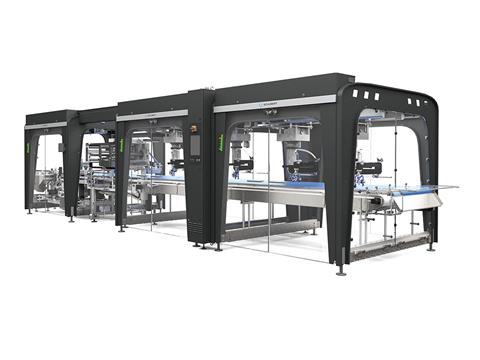
In this edition of the Spotlight, Gerhard Schubert highlights the key milestones throughout its 60 years of developing packaging machines, designed to deliver flexibility and high performance across multiple industries.
If you dedicate your life’s work to a particular goal, that goal must be significant. For Gerhard Schubert, this meant developing packaging machines that are flexible and deliver the highest performance, regardless of the industry they’re used in. For 60 years, the company has lived up to this founding idea.
It’s not an exaggeration to say that many packaging processes worldwide rely on Schubert technology. The modular TLM system developed in Crailsheim, Germany, allows nearly any packaging process to be flexibly automated. In this sense, modularity opens up many markets, a concept that has inspired Gerhard Schubert from the very beginning.
In 1959, he told one of his colleagues at the local firm Strunck about his idea of building packaging machines using a modular system. At Strunck, the plan never came to fruition. Ever the pragmatist, Gerhard Schubert registered his company on 1 January 1966, and from then on pursued the modular idea himself.
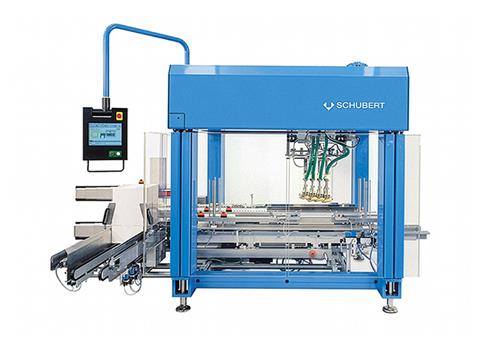
A carton erector was the company’s first commercialized machine and the first of its kind to work with hot-melt adhesive. Whether intentionally or not, the highly successful innovation laid the foundation for a modular system.
For Gerhard Schubert, the technology still needed to evolve. What good is it if a system erects and glues without also filling and sealing? These are the main functions of top-loading machines, which Gerhard Schubert was convinced had potential. He set to work on the Schubert Special Machine Construction Kit, or Schubert-Sondermaschinen-Baukasten (SSB), which comprised several assemblies, though at the time they were all mechanical ones. The development was crying out to be simplified.
Though it may seem obvious from today’s perspective, bringing production robotics into the packaging industry was a novelty at the time. This unheard-of task was precisely what Gerhard Schubert set out to achieve.
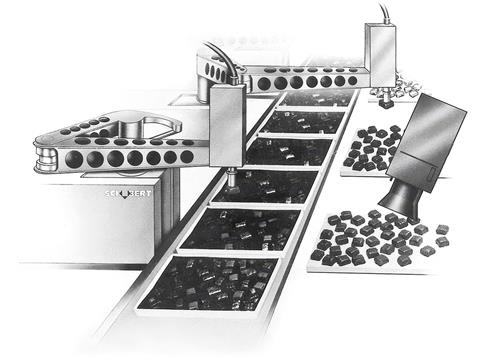
From the 1980s onwards, the company laid the groundwork for the fully robotized TLM portfolio known today: two robots – the SNC-R1, also known as “Roby”, and the SNC-F2, a pioneering bending arm robot – made it possible to fully automate the packaging of individual products for the very first time.
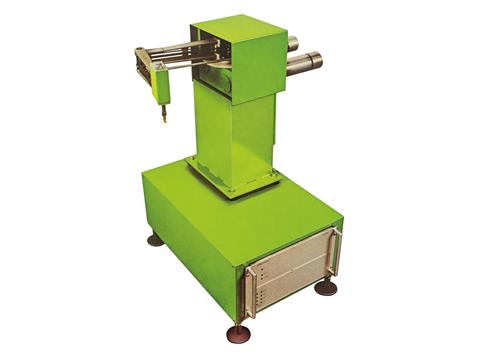
True to form, Gerhard Schubert was already thinking of the next step. Mechanical systems had been replaced by robots, but the mechanics were still holding things up in the feeding stage. If only the robots could see what they needed to pick.
Schubert won over two brilliant scientists from the former Karlsruhe Nuclear Research Centre in 1985. Dr Joseph Pecht and Dr Abdelmalek Nasraoui founded a department in Crailsheim for the development of pioneering scanners to record the quality and position of products and communicate them to the robots.
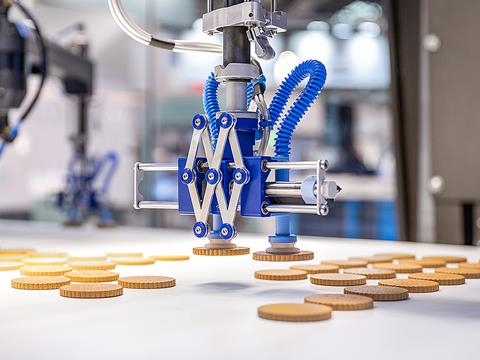
From then on, the innovations came thick and fast: 11 years later, Schubert’s VMS packaging machine controller was launched, forming the basis for the Schubert Machine Construction Kit (Schubert-Maschinen-Baukasten, SMB). The first TLM machines were brought into operation in 2000. This was followed by the introduction of the Transmodul transport robot in 2009 and the LIGHTLINE series in 2018, to name just a few of the many milestones.
And today? AI, sustainability and new packaging concepts are changing the industry. With a new generation of TLMs, Schubert remains true to its roots.
A four times stiffer machine frame, optimized robot tools and AI-based trajectory planning pave the way for more efficient packaging processes on a compact footprint. Since interpack, new-generation picker lines and flowpackers have been available on the market, and Schubert aims to roll out the new approach across the entire TLM portfolio by 2028.
This content was sponsored by Schubert.