
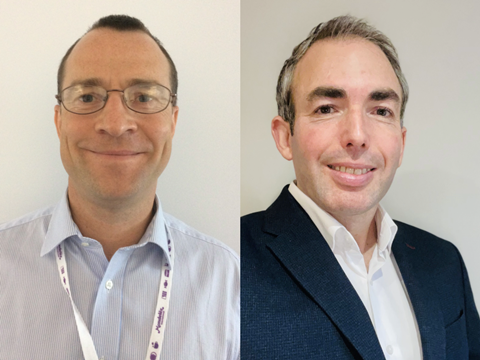
Last month we reported on HolyGrail 2030’s latest project to test intelligent sorting and recycling of flexible food-contact polypropylene (PP) packaging, and the consortium has now begun industrial trials utilizing digital watermarks. We spoke with Richard Akkermans, European R&D packaging productivity and sustainability manager at Mondelēz and Russell Avens, global packaging director at Pladis, to find out more.
First things first, please could you introduce this news for our readers who may have missed it the first time around?
Akkermans: If people missed it, the exciting news is that the 80+ strong industry consortium working on HolyGrail 2030 has announced that we have moved to industrial trials of intelligent sorting of flexible food-contact polypropylene packaging enhanced with digital watermarks.
This builds on the high sorting rates previously achieved for rigid plastic packaging in HolyGrail 2.0 and pushes towards the even harder challenge of sorting food-contact flexibles.
The sorted material will then be recycled in Q4 2026 and converted back into flexible packaging in the first end to end market demonstration of its kind globally for flex PP.
How did your company get involved in the HolyGrail project, and what motivated the company to take part?
Avens: For Pladis, HolyGrail starts with a simple reality: a pack can do everything right on shelf and still be hard to recognise once it reaches a recycling centre.
Our packaging has to protect the product, keep it fresh, run efficiently through our factories, look right for consumers and meet strict food safety requirements. Flexible packaging does that incredibly well. But once it has been used, it becomes one of millions of lightweight packs moving at speed through the recycling system. At that point, the question becomes: does the system know what it is, what it was used for, and where it needs to go next?
That was our motivation for taking part. HolyGrail is about giving packaging a more accurate identity after use. Digital watermarking has the potential to help sorting systems distinguish between materials and applications in a much more precise way, including whether a pack previously held food.
Akkermans: Mondelēz International’s ambition is to push towards full circularity of our packaging materials. Of all the mono-pack materials that pass CEFLEX’s Design for a Circular Economy (D4ACE) guidance, food-contact PP flexibles currently have some of the lowest sorting and recycling rates, despite the essential role they play in keeping food fresh and food-safe for consumers.
As a snack company using a lot of these packaging materials, the HolyGrail 2030 project represents an important workstream for Mondelēz to help prove the feasibility and viability of making flexibles circular.
What specific role will your company play in this latest stage of the HolyGrail project?
Avens: Pladis’ role is to bring real packaging and real technical experience into the trial.
We are working with our suppliers and consortium partners to incorporate invisible digital watermarks into existing pack designs, including our Sultana packs in Belgium. That sounds simple, but in practice it means making sure the pack still performs across every part of its life - from production and filling to shelf impact, consumer use and food safety.
The important point is that this is not a desktop exercise. These are packs entering a real collection and sorting system. That gives the industry a much better view of what happens when the technology meets real-world conditions: creases, contamination, different lighting, different pack shapes and the realities of a sorting line.
For us, the value is in the learning. We are contributing our packaging expertise, but we are also there to listen to the data. Circularity will not be unlocked by one company working alone. It will depend on brands, suppliers, waste systems, recyclers and policymakers understanding what works at scale - and what still needs to change.
Akkermans: Along with Pepsico and Pladis, Mondelēz already has already placed digitally watermarked flexible packaging on the Belgium market. In partnership with AIM, DigiMarc, Fost Plus and Pellenc ST, preliminary sorting trials at Hündgen Entsorgung have already started.
Further to this, Mondelēz chairs the Technical Leadership Team for the project, along with its sister project on rigid PP packaging, helping steer both projects towards the goal of re-creating packaging from intelligently sorted and advanced recycled material.
Why are flexible polypropylene (PP) packs the central focus of this stage of the project, and why are they currently so difficult to sort and recycle?
Akkermans: Of all the mono-pack materials that pass CEFLEX’s Design for a Circular Economy (D4ACE) guidance, food-contact PP flexibles currently have some of the lowest sorting and recycling rates, despite the essential role they play in keeping food fresh and food-safe for consumers.
Flexibles are typically more difficult to collect and sort however, and this, coupled with the low historical demand for recyclates due to lack of food-contact approval, has meant that infrastructure for recycling them is lagging behind.
So by focusing on this packaging type, as the material with the biggest recycling gap to close, and demonstrating what is needed to increase the circularity of food-contact recycled PP, the belief is that we can not only build a roadmap to increase its recycling rate, but also that many of the learnings will then also be transferable to other packaging types that already have higher recycling rates.
Avens: Flexible polypropylene is a critical format for snacks because it is light, efficient and excellent at protecting quality and freshness. That matters. Packaging has to prevent waste as well as reduce waste.
But the same qualities that make flexible packs so useful can make them difficult to recycle. They are thin, light and often crumpled or flattened after use. On a high-speed sorting line, a biscuit wrapper, a snack pack and non-food flexible packaging can look very similar. Traditional sorting can often identify the material, but it cannot always provide the more detailed information needed to create cleaner, food-grade recycling streams.
That distinction is crucial. If we want more food packaging to be recycled back into food-safe applications in future, the system needs to know much more precisely what a pack was used for. Food-contact packaging rightly has very high safety standards, so better sorting is not a nice-to-have, it is fundamental.
Digital watermarking could help bridge that gap. I would not describe it as a silver bullet, because packaging circularity is too complex for that. But it could be a very important piece of infrastructure for a smarter recycling system.
What will success in this project look like for you? Are there any key goals or objectives?
Akkermans: Currently, the only technology available for providing food-contact flexible PP packaging is chemical recycling, allocated through mass balance, which Mondelēz has already started to use in brands like Cadbury Dairy Milk in the UK, Freia in Norway and Marabou in Sweden.
Mondelēz, along with the rest of the HolyGrail 2030 consortium, believes that to successfully meet the ambitious PPWR targets for recycled content in food-contact plastic packaging in both 2030 and 2040, multiple complementary recycling technologies will need to be developed.
The HG2030 goal is to identify and demonstrate the end to end combinations of technologies that have the best chance of increasing the availability, compatibility and affordability of food-contact recycled PP so that we can drive this valuable packaging type towards circularity.
Avens: Success for Pladis is evidence we can act on. We want to understand how reliably the watermark can be detected, how accurately packs can be sorted, how the technology performs once packaging has been through real consumer use, and what that could mean for recycled material quality.
A good outcome is not simply saying, “the technology works.” It is being much more specific: where does it work, under what conditions, what would need to improve, what would it cost to scale, and what role could it play in meeting future recycled content requirements for food packaging?
For Pladis, the bigger objective is to help make flexible packaging circularity more credible and more scalable. Under Happy People, Happy Planet, we are focused on reducing virgin plastic use, improving recyclability and cutting waste. This trial can help us understand how better sorting technology could support those goals while protecting the product quality and food safety consumers expect from our brands.
The real prize is not a better pilot. It is a better system. If HolyGrail helps the value chain move from broad ambition to practical, investable solutions, then it will have done something very important.
If you liked this story, you might also enjoy:
The ultimate guide to packaging innovation in 2026
Packaging and Packaging Waste Regulation: what to know in 2026
Everything you need to know about global packaging sustainability regulation



No comments yet