
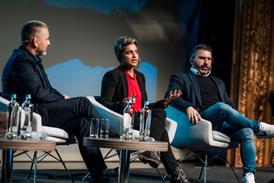


Speaking at the World Economic Forum in Davos, PepsiCo CEO Ramon Laguarta argued that corporations must “reframe” the debate around green premiums in their product prices.
The discussion was raised by André Hoffmann, interim co-chair of the World Economic Forum’s Board of Trustees, who asked Laguarta how companies justify green premiums to their shareholders.
“How do we [companies] reframe the problem?” Laguarta responded. “This is not about sustainability or profitability. This is about short-term or long-term.”
He acknowledged that PepsiCo considers growth to be its business model, but adds that the company “need[s] to generate this growth without depleting the resources that will give us this”.
“It’s a very simple framing of the problem,” he admitted, “but it has to be owned by the board, it has to be owned by obviously the CEO and the management team – and then the hard work is, how do you make it operational in the business?”
Laguarta pointed to PepsiCo Positive (pep+), a strategic framework that targets a circular and inclusive value chain, responsible ingredient sourcing, and more. He asserted that PepsiCo has made good progress in its goals for agriculture and water, but identified “hiccups” and “trade-offs” in other areas.
“We’re not making so much progress in circularity,” he conceded. “I would put it at the centre of opportunity because if we get to scalable circularity, we can really make an impact on the resources that we use, and that is positive for the system.
“This is not about everyone doing the little thing. This is about all of us joining forces and making change at scale.”
While he acknowledged that such widespread change is “a very complex topic”, but emphasized the importance of leadership, resources, accountability, and discipline in the ongoing effort.
“We see ourselves not only as taking care of our own company,” Laguarta added. “We are partners of governments.
“Please see us as agents of change, because we want to be leaders in an ecosystem that needs to change at scale. We see ourselves as innovators or first-movers in new materials and technologies, and we can afford some cost of experimentation.”
Laguarta’s statements follow PepsiCo’s scaling back of its packaging targets for 2030. This came after the company predicted in its 2023 ESG Summary Overview that it would fall short of its 100% recyclable, compostable, biodegradable, or reusable packaging target.
The company attributed the revision of its targets to limitations outside its control, such as China’s ban on using recycled PET in food-grade packaging, but stated its intent to ‘remain ambitious’ with its sustainability targets.
According to its 2024 ESG Summary, PepsiCo achieved a 15% increase in recycled plastic across its primary packaging in key markets between 2023 and 2024, alongside a 5% reduction in virgin plastic tonnage.
In other news, Nestlé chief executive Philipp Navratil allegedly blamed US President Donald Trump for the company’s reserved stance on sustainability, arguing that the United States has “totally gone off the agenda.”
If you liked this story, you might also enjoy:
The ‘complex reality’ of reusable packaging in Europe
Single-use packaging versus reusable packaging: Which is more sustainable?
The ultimate guide to global packaging sustainability regulation













No comments yet