




Molded pulp has been around for decades in the form of egg cartons, fruit trays, and electronics inserts. Everyone in packaging knows what it is, but the question has always been: can it ever truly replace plastic in mainstream packaging applications? Design for Sustainability consultant Zhanar Baishakova takes a closer look at this trend.
For a long time, traditional molded pulp had four major limitations as compared to plastic.
- It struggled to deliver the design flexibility, precision, premium appearance, and mechanical performance expected in many consumer-facing applications.
- It struggled with grease resistance, water resistance, moisture protection, and oxygen barrier performance.
- It could lose strength in humid conditions and often needed thicker walls to deliver comparable protection.
- It was slower to manufacture and more expensive.
But things have shifted in the last few years. What’s particularly interesting is that the industry is making progress on all those fronts at the same time.
Design flexibility is improving
This is an area where the industry is making progress. Companies such as Huhtamaki have invested heavily in thermoformed fiber technologies that deliver smoother surfaces, improved precision, and a more premium look and feel than traditional molded pulp. The company has commercialised fiber-based solutions such as oven-safe ready-meal trays, as well as molded fiber cold-drink lids trialled with Starbucks.
Thermoformed fiber is not the only pulp technology changing what molded pulp can look and feel like.
German company PAPACKS is also advancing with Fiber Casting technologies that enable increasingly sophisticated packaging formats, from bottles and tubes to pharmaceutical and premium consumer packaging. The ability to create sharper geometries, tighter tolerances, and more functional designs is helping expand the range of applications where fiber can compete with plastic.
Advances in tooling, process control, and forming technologies are helping narrow the gap between fiber and plastic when it comes to aesthetics and design freedom. Molded pulp still cannot match every shape, closure, or finish that plastic can achieve, but the range of applications where it can deliver an attractive consumer experience is expanding rapidly. And with major food and beverage brands now willing to co-develop bespoke solutions, the pace of that expansion is accelerating.
Perhaps the most important shift is that companies are increasingly designing packaging specifically for fiber rather than trying to replicate existing plastic formats. That change in mindset is opening possibilities that were difficult to achieve when fiber was simply expected to imitate plastic.
The barrier problem is finally being addressed
Barrier performance has always been molded pulp’s biggest weakness. If packaging needs to keep grease in, moisture out, or oxygen away from a product, whether it’s food, cosmetics, or pharmaceuticals, conventional molded pulp quickly reaches its limits. For years, the industry relied heavily on PFAS-based coatings to improve performance. As regulatory pressure on PFAS continues to increase in Europe and North America, suppliers have been forced to find alternatives.
Some of the most significant progress is now happening in commercial foodservice applications. Companies such as Solenis and Sabert have already brought PFAS-free coated molded fiber products to market.
Solenis developed its Contour technology for molded fiber foodservice applications such as plates, bowls, tubs, and trays, addressing one of the industry’s practical challenges: applying barrier coatings consistently to complex three-dimensional shapes. The company has also partnered with Zume to scale PFAS-free molded fiber packaging for foodservice applications.
The biggest challenge remains high-barrier applications. Molded fiber still struggles to provide the combination of oxygen barrier, moisture protection, and shelf-life performance required for many pharmaceutical, modified atmosphere packaging (MAP), and premium food applications.
However, commercial PFAS-free solutions are already proving themselves in foodservice, while the next generation of biodegradable polymers and nanocellulose technologies is pushing molded fiber closer to applications that would have been considered out of reach only a few years ago.
Manufacturing speed is catching up
Even if performance improves, packaging still must compete economically. Historically, molded pulp struggled here. Conventional wet molding processes often require cycle times of 30 to 60 seconds. Plastic injection molding can operate in a fraction of that time, making it difficult for molded pulp to compete in high-volume applications.
This is where dry molded fiber has attracted so much attention. Swedish company PulPac, founded in 2018, has developed its Dry Molded Fiber technology over the past seven years. Instead of creating a water-based slurry, fibers are processed in a dry state, formed into a web and compressed using heat and pressure.
The result is dramatically faster production. PulPac reports cycle times as low as 3.76 seconds for selected applications, with production rates reaching approximately 23,000 lids per hour. While performance varies by product and manufacturing setup, these numbers demonstrate that fiber can now compete in some plastic applications.
And beyond speed, dry molded fiber also reduces water consumption, factory footprint and energy requirements, helping improve the overall economics of fiber packaging.
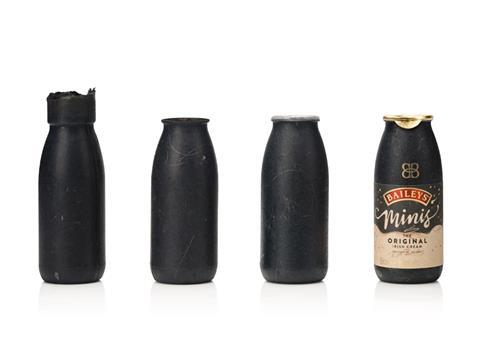
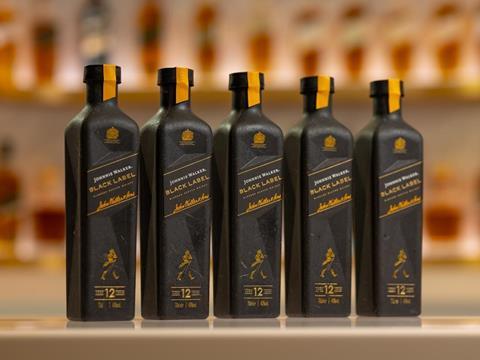
What’s particularly interesting is how quickly the technology is moving beyond relatively simple applications such as lids and foodservice packaging. Through the Bottle Collective, companies including PulPac, PA Consulting, Diageo, Haleon, Opella, and other partners are exploring fiber bottle systems for beverage, consumer health, and FMCG applications.
Increasingly, the focus is shifting from proving the concept to demonstrating industrial scalability and performance.
These are still trials rather than commercial launches, but they demonstrate something important: the same technology capable of producing a coffee cup lid at industrial speed is now being evaluated for one of the world’s most recognisable spirits brands. That is a strong signal of how far dry molded fiber has progressed in a relatively short period of time.
Dry molded fiber is not the only route to high-volume production.
For example, PAPACKS has shown that advanced wet molded fiber technology Fiber Casting can also achieve industrial production volumes, supported by manufacturing operations in Germany and the Netherlands.
In December 2025, the company unveiled its Model S10 — a patented, automated production system designed to manufacture fiber-based bottles, containers, and tubes, with a starting capacity of ten million units and a modular roadmap scaling up to 100 million units annually — a clear signal that the push for high-speed, high-volume fiber production is moving well beyond early-stage development.
Mechanical performance is improving too
Most innovation in this space focuses on barrier performance or manufacturing efficiency. But mechanical performance, the ability of a package to hold its shape, survive transport, stack reliably, and withstand the demands of real supply chains, remains one of molded pulp’s most persistent weaknesses.
PAPACKS has taken an interesting approach by looking not only at manufacturing technology but also at the raw material itself. Rather than relying on conventional wood pulp, the company has developed solutions based on industrial hemp fibers. Hemp grows quickly, requires relatively low agricultural inputs, and offers stronger mechanical properties than many conventional fiber sources, helping improve rigidity and dimensional stability without adding weight.
What’s interesting is where these solutions are starting to appear. PAPACKS’ Fiber Box for temperature-sensitive seafood logistics won a German Packaging Award in 2025 and is already being used commercially by Transgourmet Seafood. The company has also partnered with Bayer to develop fiber-based packaging for consumer health.
These are demanding applications. Cold-chain logistics and pharmaceutical packaging place some of the toughest requirements on packaging performance, making them useful indicators of how far molded fiber technology has progressed.
Taken together, these projects reflect something broader. Mechanical performance, barrier properties, and manufacturing scale are no longer being solved in isolation. The companies making the most progress are tackling all three at the same time.
What’s next?
What’s particularly interesting is that most people only see what’s already commercial. But there is a lot happening behind the scenes.
One area attracting significant attention is design flexibility and functionality. Design innovation is also moving beyond appearance. Increasingly, developers are integrating functional features directly into fiber structures, including closures, hinges, stacking features, and tamper-evident designs that previously relied on additional plastic components. This is helping expand not only what fiber packaging looks like, but also what it can do.
Another area attracting significant attention is next-generation barrier technologies. While grease and short-term moisture resistance are increasingly being addressed commercially, higher oxygen barriers and long-term moisture protection remain more challenging.
This is where companies such as OrganoClick, PulPac and Nordic Barrier Coating are focusing their efforts. Their BioInnovation-funded collaboration is exploring bio-based, plastic-free and PFAS-free barrier materials for Dry Molded Fiber applications while maintaining recyclability and compostability.
Others are investigating bio-based coating technologies, including PHA-based systems that combine barrier performance with biodegradability and compatibility with paper recycling streams.
Beyond barriers, researchers are also investigating how to address higher rigidity, dimensional stability, and overall package strength without compromising recyclability or compostability. Cellulose nanofibrils, mineral-based coatings, shellac-based coatings, lignin-derived materials, starch-based binders, chitosan, and other bio-based solutions that could improve both barrier performance and mechanical properties.
It is clear that molded pulp innovation is accelerating, not slowing down. The material itself may be mature, but the technology around it is evolving surprisingly fast.
A few years ago, most innovation focused on replacing relatively simple plastic packaging. Today, companies are targeting applications that were traditionally considered too demanding for fiber, including high-barrier food packaging, pharmaceutical packaging, lower-plastic fiber bottles, bottle lids and modified atmosphere packaging (MAP).
These remain some of the most challenging packaging formats on the market today. The fact that companies are now actively pursuing them suggests just how far molded pulp has come, and how much further it may still go.
So, what should brands do?
The molded fiber market is growing quickly, driven by regulation, corporate sustainability commitments, and technology improvements.
Understandably, much of the industry’s attention today is focused on PPWR compliance, recyclability targets, and the transition towards mono-material packaging structures. Those are immediate priorities, and rightly so.
But focusing only on today’s requirements can sometimes make it easy to miss what is coming next. The biggest risk for many brands today is not moving too early, but moving too late.
Beyond PPWR, the European Commission is currently updating its Bioeconomy Strategy to accelerate the uptake of bio-based materials and strengthen Europe’s resource resilience. The details are still evolving, but the long-term direction is clear: renewable and recyclable materials are likely to play a growing role in future packaging systems.
That is why now is a good time for brands to start building capability. Partner with innovators. Run pilots. Test the limits of the technology. Understand where fiber can and cannot create value within your packaging portfolio.
The value of a pilot is not always to validate a solution. Sometimes the greatest value comes from understanding where a technology does not work today, and where it may become viable much sooner than expected.
If you liked this story, you might also enjoy:
The ultimate guide to packaging innovation in 2026
Packaging and Packaging Waste Regulation: what to know in 2026
Everything you need to know about global packaging sustainability regulation












No comments yet