



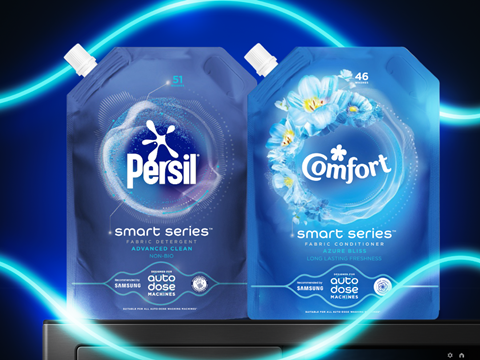
Unilever’s new Persil and Comfort Smart Series detergents are intended for auto-dose washing machines from Samsung. How does the product packaging fit into this growing market, and does it align with Unilever’s ongoing sustainability goals?
Packaging Europe attended a media panel and spoke with Tati Lindenberg, chief marketing officer at Unilever Home Care, to learn more.
With one in four homes expected to use an auto-dose washing machine by 2030, Unilever is catering its Smart Series lineup to overwhelmed, time-constrained consumers looking to smart technology as a simple and efficient laundry solution.
Samsung’s Auto Dispense technology is designed to store detergent for up to one month of washing, based on an average of 2-3 cycles per week. Instead of requiring a consumer to refill the detergent drawer with every wash, it automatically dispenses the correct amount of detergent per load.
“Smart auto-dose machines are capable of understanding not just how much laundry you have, but even the type of fabric and the type of dirt,” Lindenberg explained. “That, of course, changes the way in which the machine will dose the amount of product, and it was essential for us to create a product that could consistently, regardless of the load, deliver top performance.”
As part of this streamlining initiative, Unilever is trialling its Smart Series product through a direct-to-consumer approach – and with the growing popularity of online retail, d-commerce, and subscription-friendly delivery formats, the Smart Series packaging was designed with transportation in mind.
“Needless to say, it’s a DTC model, so we also needed the product to be very lightweight,” said Lindenberg. “Then we could deliver it via d-commerce.”
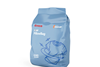
We asked Lindenberg why the new line is packaged in a flexible plastic pouch. Recycling these formats has proven to be challenging, and it is for this reason that Unilever extended its deadline to achieve 100% recyclable, reusable, or compostable flexible plastic packaging by an extra ten years.
Equally, Unilever has transitioned other laundry products into recyclability-minded packaging formats; in the UK, its Wonder Wash detergent bottles are now said to contain up to 100% post-consumer recyclate, excluding lids and caps. The company has also stated its intent to transition more products into paper-based flexible packaging this year.
“This [Smart Series detergent] is a very unique product, because it’s the first time that we are asking people to use and dose the product once,” Lindenberg responded. “We have explored many different packaging solutions, and we wanted to find one in which people would understand that they only have to use it once.
“Previously, we did have the more traditional bottles – the same ones that you see in an average detergent in supermarkets – but we noticed that a lot of people would dose just half of it, or they would dose the entire bottle. Then they would complain, rightly so: ‘Why do we need a bottle with all this material just to use it once?’
“Is [flexible plastic] the best-ever solution that we could have for one usage? No. We are exploring other options; PET bottles, for instance, which are easy to recycle, as well as paper pouches. All of this is in our pipeline.
“For this moment, we are using the best technical solution that we have available, but we will definitely keep pursuing the development of alternatives that could, once we scale it up, bring a more sustainable solution.”
Packaging that fails to account for mess and leakage can also impact the long-term health of a washing machine, and Lindenberg pointed out that dosing can be a pain point when designing laundry detergents and conditioners.
“That was actually a key requirement in all the market research that we’ve done,” Lindenberg told us. “People said, ‘How can I make sure that when I pour this into the reservoir, there will be no mess?’”
To account for the lack of a cap or dosing device, the Smart Series pouch features a plastic nozzle for precise and accurate pouring. We asked Lindenberg whether more efficient dosing could have a knock-on effect of reduced packaging waste.
“It means less product in general,” she said. “We do know that across different markets, consumers sometimes tend to overdose. This is not on account of anyone trying to use more and more product.
“Even if you are a scientist within Unilever, [dosing per cycle] is not as impeccable as what a Samsung machine, for instance, could do. So, in fact, we can potentially think about consumption reduction in the future.”
Samsung also claims that its auto-dose washing machines reduce detergent use by up to 15% by analyzing the amount of detergent used in its last ten cycles. However, it remains unclear whether this technology leads to a substantial reduction in packaging waste.
Nevertheless, AI functionality also factored into the packaging design, with the on-pack ‘orb’ – designed in collaboration with Design Bridge – appearing across Unilever’s ‘Detergent Optimization & Smart Estimation’ (D.O.S.E.) campaign. This involved partnering with influencers in the home care space and starting a conversation on social media about the necessity of automated laundry processes, aiming to position Persil and Comfort as brands that keep up with scientific, technological, and cultural developments.
“Design Bridge was enthusiastic about how we could use AI knowledge to inform not only the packaging design, but also the entire visual world we have in the campaign, across different touchpoints,” said Lindenberg. “We believe this is a beautiful way of showing the technology and also building more desire for laundry products, which are usually not associated with being the most desirable products in the world.”
We concluded the interview by asking Lindenberg whether she expected the ‘orb’ design to stand out on the shelf and help consumers associate the Smart Series detergents with auto dose laundry technology.
“I hope they do!” she replied. “In isolation, it’s a lot to ask, but what we’ve been doing is using the orb across different touchpoints, and the orb has a lot of power when it moves. The fact that we have a social-exclusive campaign also helps, because consumers will be able to see the orb on the packaging, but they will be able to see the orb and the explanation behind it across different digital touchpoints.”
If you liked this story, you might also enjoy:
The ultimate guide to packaging innovation in 2026
Packaging and Packaging Waste Regulation: what to know in 2026
Everything you need to know about global packaging sustainability regulation













No comments yet