




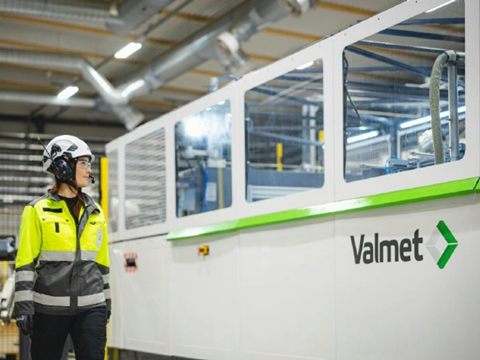
Valmet has launched its Valmet 3D Fiber technology to help customers manufacture lightweight, three-dimensional food packaging formats from cellulose fibres.
Developed in collaboration with Metsä Spring, Valmet 3D Fiber is described as a fast and high-capacity process that allows the efficient circulation of side streams and trim waste within the production process. This is expected to improve overall process efficiency and help support a circular economy.
The technology and its end products are expected to help customers unlock wider market opportunities than wet moulded fibre alternatives, with Valmet 3D Fiber recommended as a solution for trays, plates and other food packaging made from cellulose.
Valmet expects this solution to help promote renewable materials and resource efficiency, and to underline its own strategic focus on ‘continuous innovation’ alongside its customers in pursuit of circularity.
“The strength of Valmet 3D Fiber lies in combining unique fibre layering technology, production capacity, and automation,” says Juho Pyrrö, head of Valmet 3D Fiber.
“Our technology enables customers to develop demanding three-dimensional packaging solutions, while maintaining high productivity and resource efficiency.”
“The demand for moulded fibre packaging solutions is growing, and we see strong opportunities to help our customers capture this growth,” adds Petri Rasinmäki, executive vice president, Packaging and Paper at Valmet.
“By combining strong expertise in fibre-based packaging and paper process technologies and automation, Valmet is able to offer packaging producers a competitive end-to-end solution.
“With Valmet 3D Fiber, we support our customers in seizing new business opportunities, strengthening their market position, and accelerating the shift toward fibre-based packaging.”
In another recent development, Valmet has introduced its software-based IQ Virtual Sensor – designed to help paper and board mills maintain consistent quality, reduce fibre and starch costs, decrease energy consumption and increase overall production efficiency.
Z1RO has also manufactured moulded fibre packaging – this time using lignocellulosic feedstocks like agricultural residues, European bamboo, hemp hurds and fallen leaves. This is hoped to combine functional performance with a ‘premium’ tactile experience.
If you liked this story, you might also enjoy:
The ultimate guide to packaging innovation in 2026
Packaging and Packaging Waste Regulation: what to know in 2026
Everything you need to know about global packaging sustainability regulation














No comments yet