




Greyparrot states it has raised $27 million (€23 million) in Series B funding led by investor Omar Mir to help scale its AI waste intelligence system, aiming to help avoid over one million tonnes of waste by 2030.
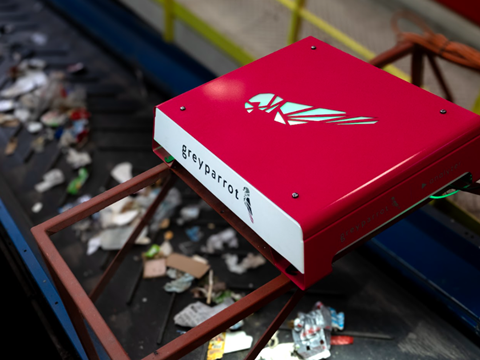
The company says that the investment follows a major milestone for its AI, which has now detected ‘more than one trillion’ waste objects. Greyparrot’s AI camera systems (known as Analyzers) are installed above sorting belts in recycling facilities in over 20 countries, designed to identify materials, products and brands in real time and give operators continuous data on the composition and movement of waste through their facilities.
Waste and recycling companies including Veolia, Biffa and FCC are currently utilizing Greyparrot’s technology to improve recovery rates, monitor material quality and run more profitable facilities. Continuous visibility is said to help operators improve yield, strengthen audits and compliance reporting, and plan for waste-stream changes resulting from regulation. Greyparrot says facilities using its real-time AI data have reported efficiency gains of 10% to 30%, with one site saving more than £1.5 million in a year.
In a reported ‘UK first’, the Environment Agency accepted Greyparrot AI-derived waste composition data for statutory compliance reporting in Q1 2026, in submissions from customers Biffa and FCC. Apparently, across Greyparrot’s network, the materials identified by its Analyzers represent an estimated £1.87 billion in recoverable value, including 17.4 billion PET bottles and 4.2 billion aluminium items.
Commenting on the impact of the Series B funding, Mikela Druckman, co-founder and CEO of Greyparrot, said: “This funding lets us scale rapidly across North America and Europe and grow our AI, data science and product teams. The technology, market demand, urgency and momentum are all here, and we are ready to scale our impact.”
In May this year, Greyparrot partnered with Kenvue to improve global recycling for its brand packaging in commercial-scale sorting facilities. Using Greyparrot’s Deepnest platform, Kenvue hopes to validate the performance of its packaging in sorting facilities as regulatory frameworks like the EU’s Packaging and Packaging Waste Regulation (PPWR) and Extended Producer Responsibility (EPR) tighten.
In related news, PepsiCo has announced a multi-year collaboration with Siemens and NVIDIA, aiming to transform its plant and supply chain operations through advanced digital twin technology and AI. The company says it is shifting to a digital-first planning strategy, leveraging physics-based digital twins and AI agents as co-designers to simulate, validate, and optimize facility layouts before any physical build.
If you liked this story, you might also enjoy:
The ultimate guide to packaging innovation in 2026
Packaging and Packaging Waste Regulation: what to know in 2026
Everything you need to know about global packaging sustainability regulation








No comments yet