


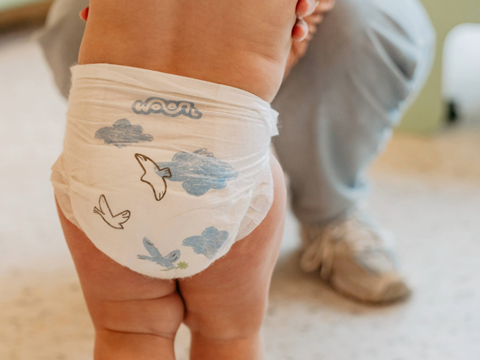
Borouge International and BlueAlp are working with Woosh to chemically recycle disposable baby diapers into pyrolysis oils for producing new polymers.
Consumption data suggests that 6.73 million metric tons of disposable diapers were generated in the EU-28 in 2017. These products are often incinerated or sent to a landfill after a single use, but Borouge points out that they contain ‘valuable’ polyolefin-based nonwovens and films.
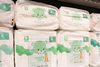
The collaboration builds on the pre-established ecosystem around Woosh’s give-back diapers, which are distributed to households and childcare facilities across Belgium, then collected again after use.
Over 30,000 children are currently thought to use the system every day, with Woosh processing ‘thousands’ of metric tons of used diapers annually at its recently-launched diaper recycling plant.
Woosh aims to expand its operations into France and the Netherlands to increase the volume of recovered plastic available for recycling.
Now, engineers from Woosh have worked alongside Borouge International and BlueAlp to define the quality requirements of any recovered plastic to be used as input for BlueAlp’s chemical recycling technology. Woosh has adjusted its proprietary mechanical separation process accordingly.
Initial industrial-scale recycling runs took place at BlueAlp’s plant in Oostende, Belgium. Its pyrolysis technology was used to process the recovered plastic fractions, converting them into ISCC PLUS-certified pyrolysis oil for future polymer production.
This is thought to be the first time a circular economy has been established for single-use diapers at an industrial scale in Europe, and is intended as a proof of concept for circular systems in the sector.
“Chemically recycling the plastic from used diapers is anything but straightforward,” explains Peter Voortmans, vice president Marketing Consumer Products at Borealis. “It requires careful pre-processing to meet the specifications of the pyrolysis process.
“Together with Woosh and BlueAlp, we’ve been able to solve this challenge, showing what’s possible when teams work closely together with a shared goal.”
“We have spent years building the collection network and the technology to make this possible,” continues Woosh CEO Jeff Stubbe. “To see the plastic we recover from used diapers validated as feedstock for new polymer production, and potentially for new diapers in the future, is exactly what we set out to achieve. This is what closing the loop actually looks like.”
“This is a fundamental example of what we want to achieve at scale with BlueAlp,” adds BlueAlp CEO Valentijn de Neve. “It’s fantastic to see that, together, we can address difficult-to-recycle waste streams that cannot be effectively managed through mechanical recycling, enabling them to be chemically recycled and returned to demanding applications such as diapers in the healthcare and hygiene sector.”
In other diaper-related news, Korozo Group, Drylock Technologies, and Colruyt have worked together to create a recyclable, nonwoven packaging solution for diaper products. Together, the companies sought to unlock a tactile experience that reflects the product’s softness.On the topic of chemical recycling, Borealis also joined forces with Clariant and SINTEF in a pilot-scale project to upgrade pyrolysis oil from plastic waste into cracker-grade feedstock, which is said to be suitable for virgin polyolefin production.
If you liked this story, you might also enjoy:
The ultimate guide to packaging innovation in 2026
Packaging and Packaging Waste Regulation: what to know in 2026
Everything you need to know about global packaging sustainability regulation









No comments yet