

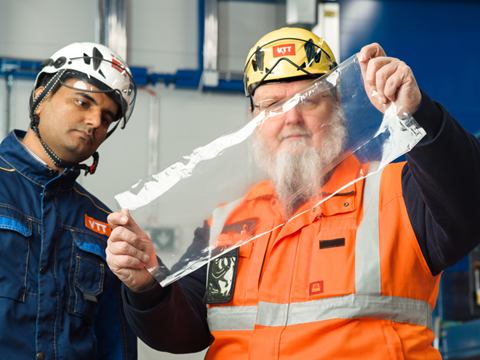
LUT University and VTT Technical Research Centre of Finland have completed a project to demonstrate the feasibility of recyclable, biodegradable films and coatings at pilot scale – intended to help reduce or replace fossil-based plastics.
F3 – Films for Future is a cellulose-based material platform funded by the European Regional Development Fund (ERDF) and undertaken alongside research organizations, industry partners and funding bodies.
Completed in March 2026, the project claims to have showcased the potential of biobased films as a standalone, transparent and biodegradable material; and as a high-performance barrier layer that supports recyclability in fibre-based packaging systems while enabling biodegradability when required.
Contributors have built on advances in cellulose dissolution and regeneration to manufacture films with high transparency, mechanical strength, and barrier properties. Through conventional methods such as thermoforming, the partners claim to have proven the processing compatibility of their material in line with existing industrial infrastructure.
Reportedly, the technology processes cellulose as a polymer rather than a fibre. This has resulted in transparent films with mechanical and barrier properties that the project partners compare to those of conventional plastics.
The films are said to deliver oxygen-barrier performance comparable to conventional plastics at 23°C and 50% RH (oxygen transmission rate below 1 cc/m2/day). Similarly, the coatings are believed to unlock oxygen (OTR below 0.2 cc/m2/day) and grease barrier (KIT 12) functionality in recyclable fibre-based packaging systems.
The F3 material platform is designed to integrate with existing converting technologies, complement current recycling streams or biodegradation pathways, and avoid any trade-offs between functionality and end-of-life handling.
It responds to increasing regulatory requirements around recyclability, material composition, and lifecycle impact, including those mandated by the Packaging and Packaging Waste Regulation – advancing the technology from laboratory development to scalable manufacturing.
The next phase is set to scale the technology towards commercial applications, including initial use cases in dry food packaging, bakery products, and fibre-based packaging that requires transparent barrier layers. It will target barrier performance under humid conditions and integrate multiple functionalities within a single material system.
Furthermore, the platform is hoped to unlock multifunctional applications like antimicrobial or antioxidant functionality, or active and intelligent packaging that reacts to humidity, gas composition, or pH. Digitalization is also expected to play a role through sensor-enabled or connected packaging.
“Plastic films are one of the most widely used packaging formats, yet they are among the most difficult to recycle and a major source of persistent environmental pollution,” says Ali Harlin, research professor at VTT and one of the leading coordinators of the F3 project.
“At the same time, we are working with manufacturers to help them meet evolving regulatory requirements while maintaining product protection, shelf life, and process efficiency. Cellulose materials open new sustainable solutions for packaging.”
“The key challenge has not been whether alternative materials exist, but how to process them in a way that meets industrial requirements,” explains Vinay Kumar, senior scientist at VTT.
“What has now been demonstrated is a future-ready material platform that offers an alternative to plastics, combining sustainability with the capability to integrate into existing manufacturing and recycling systems. We see strong potential to develop this further together with industry partners.”
“The cellulose films and coatings have already been demonstrated to have the properties to be processed in various package converting processes, which highlights their future potential,” comments Ville Leminen, professor of Packaging Technology at LUT University.
“Finding the right balance between functionality and sustainability is critical for the future of packaging,” continues Carl-Erik Guttormsen, area director at Colombier Finland.
“Through the F3 project, we have bridged this gap by developing fully plastic-free barrier coatings that deliver high performance without ecological compromise.
“Utilizing our off-line coating line, we are now able to commercialize these solutions on paper and board for demanding food packaging applications.”
“From an industry perspective, scalability and system compatibility are critical factors,” says Riku Talja, development manager at Metsä Board. “Solutions that align with current converting technologies and recycling infrastructure are far more likely to transition from pilot-stage innovation to industrial use.”
“Value chain adoption of these platforms is essential for the ongoing transition towards fully renewable and recyclable technologies,” adds Mats Berg, senior principal scientist, Discovery & Innovation at Kemira. “We see chemistry as the key enabler for this transition.”
In other news, Paramount Planet Product was nominated as a finalist in the pre-commercialized Climate category of last year’s Sustainability Awards for its flat sheets entirely made from fibrillated cellulose. Formed without synthetic binders, the material is said to be suitable for use in packaging, barrier films, and coatings while remaining fully compostable on land and underwater,
Our latest edition of the Brief also took an in-depth look at the European Commission’s analysis of biobased feedstock in plastic packaging to answer the question: are bioplastics a viable contribution to the Packaging and Packaging Waste Regulation’s sustainability goals?
If you liked this story, you might also enjoy:
The ultimate guide to packaging innovation in 2026
Packaging and Packaging Waste Regulation: what to know in 2026
Everything you need to know about global packaging sustainability regulation














No comments yet