



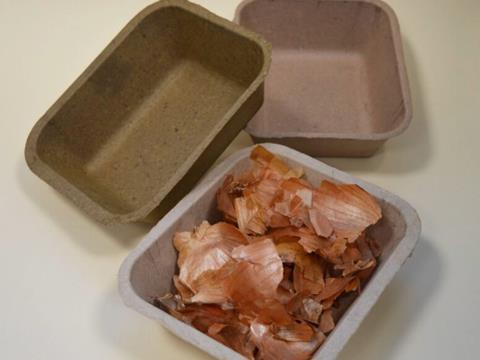
HUID utilizes onion waste to create paper-based packaging such as moulded fibre and board products. The company was a finalist in this year’s Sustainability Awards, nominated in the Pre-Commercialized Renewables category. CEO Renuka Ramanujam tells us more about this entry.
You’re a finalist in the Sustainability Awards 2025. Congratulations! To start off, could you summarize your entry, in less than 50 words?
At HUID we convert onion waste into strong, lightweight fibres for paper-based packaging applications. Using an ultra-fast and gentle proprietary processing method, we produce pulp that can be utilized in cardstock/board or moulded fibre products.
Why do you think the judges were impressed with your entry? Tell us about what is innovative about your project and/or about its impact on packaging sustainability.
I think there are two ways in which the business is innovative that may have piqued interest. First, using an untapped, everyday source of agricultural waste to produce pulp that has interesting performance properties, using gentler and more efficient methods than conventional wood pulping to reduce energy use and the need for extensive effluent treatment.
Second, the global abundance of the feedstock means we can pursue a decentralized production model that can provide income for onion packers and growers around the world whilst providing supply chain resilience. It also means the embodied carbon of the resulting product is lower with more localized production hubs.
Although the pulp is not a direct substitute for wood pulp, its utilization in blends can improve specific properties that have tangible benefits in packaging applications (weight, strength and potentially more). Even using it in proportions of 20-33% can ease pressure on wood pulp supply chains and our forests.
Finally, can you tell us about the ongoing development of your project, e.g. how your innovation/initiative has been received by the industry, or what the next steps are in commercialization/product development?
We are in the process of conducting scale up trials to optimize our process in larger volumes and working towards setting up our pilot site in partnership with onion growing partners. We are also pursuing critical certification in recyclability, food contact and biodegradation.
Due to its properties, the material has received interest from packaging manufacturers, paper mills and retail brands/companies; we have already worked with lifestyle brands to use the pulp in branding materials and are working towards some pilot projects in the near future for exciting speciality packaging applications.
Next year’s Sustainability Awards will take place during the Sustainable Packaging Summit in Utrecht, Netherlands, 10-12th November 2026. You can find out more here.
If you liked this story, you might also enjoy:
The ultimate guide to the Packaging and Packaging Waste Regulation in 2025
How are the top brands progressing on packaging sustainability?
Everything you need to know about global packaging sustainability regulation in 2025
The key to increasing the use of reusable packaging in supermarkets









No comments yet