




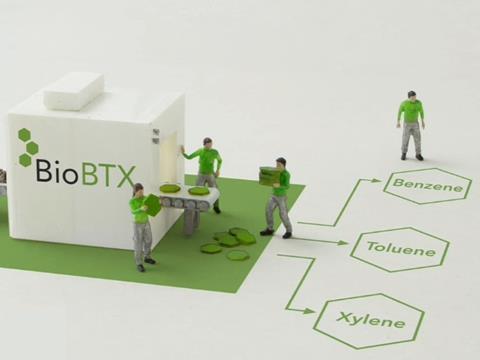
Zeopore Technologies and BioBTX have announced a ‘major advancement’ in converting waste plastics and biomass into circular aromatics, reportedly achieving up to 100% yield increase in BTX (benzene, toluene, xylene) by combining BioBTX’s Integrated Cascading Catalytic Pyrolysis (ICCP) technology with Zeopore’s tailored mesoporous zeolite catalysts.
Detailed in a joint technical article, the results show that Zeopore’s gallium-containing mesoporous ZSM-5 catalysts doubled the yield of BTX (benzene, toluene and xylene) aromatics in pilot-scale trials. The improved porosity and metal distribution of the catalysts enhanced both dehydrogenation and cracking reactions, leading to higher selectivity and less unwanted gas formation.
The collaboration is also said to have achieved a nearly 50% reduction in CO2-equivalent emissions per unit of aromatics produced. The ICCP technology from BioBTX separates the pyrolysis and catalytic upgrading stages, enabling higher control over reaction conditions and longer catalyst lifetimes.
Both companies plan to scale up the technology for commercial demonstration. BioBTX will integrate the improved catalyst design into its first renewable aromatics plant, while Zeopore continues to expand its catalyst portfolio for waste plastics and biomass upgrading applications.
In related news, last summer Plastic Energy revealed it had converted hard-to-recycle post-consumer plastic waste into pyrolysis oil at its Geleen facility, for the production of food-contact packaging, medical plastics, and more. Said to repurpose waste that would otherwise be sent to landfill or incinerated, the company’s chemical recycling process breaks down mixed plastics using heat in an oxygen-free environment, and produces a replacement for conventional naphtha in existing petrochemical plants.
More recently, we spoke with Independent Commodity Intelligence Services (ICIS) about its Pyrolysis Oil Pricing Index, a finalist in the last year’s Sustainability Awards. It’s said to provide ‘transparent’ pricing data, commentary, and analysis for chemical recycling.
If you liked this story, you might also enjoy:
The ‘complex reality’ of reusable packaging in Europe
Single-use packaging versus reusable packaging: Which is more sustainable?
The ultimate guide to global packaging sustainability regulation















No comments yet