

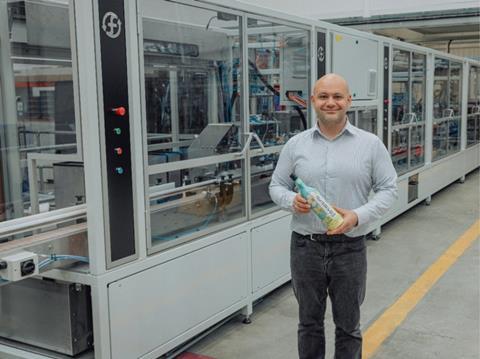
Frugalpac has revealed its high-speed FBAM-2 machine designed to increase the production of its paper Frugal Bottles, said to be capable of producing 14 million paper bottles a year.
Designed for installation at bottling plants and packaging facilities worldwide, the FBAM-2 aims to allow partners to manufacture Frugal Bottles at scale, reducing cost, carbon and supply chain risk. Its flexible multi-lane options allow for smaller and ‘significantly larger’ production volumes.
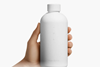
Frugalpac claims its Frugal Bottle remains ‘the world’s first and only’ commercially available paper bottle for wines, spirits and edible oils, made from 100% recycled paperboard and said to have a carbon footprint up to 84% lower than a standard glass bottle.
With the FBAM-2, the company says the cost of producing Frugal Bottles is reduced by 30% compared with current paper bottles, bringing it to price parity - or above – compared to a labelled glass bottle. Frugalpac hopes that FBAM-2 will remove the manufacturing scale constraints for paper bottles, enabling millions more bottles to be produced annually at a single site.
The new machine aims to provide opportunities for large-scale brand adoption, multi-market rollouts and integration into existing bottling operations. Frugalpac adds that it commissioned an independent Life Cycle Assessment (LCA) by Intertek in 2020, later updated in 2023. According to the results, each Frugal Bottle saves 348g of CO2 emissions compared to a glass bottle. With 4 million bottles already produced, the Frugalpac states that cumulative savings are now over 1,392 tonnes of CO2.
The company adds that the FBAM-2 enables distributed manufacturing, allowing partners Monterey Wine Company (USA) and KinsBrae Packaging (Canada) to assemble bottles on-site. It also aims to eliminate packaging miles and secure the supply chain against global glass shortages.
Last month the company announced that Mother of Pearl Vodka would serve drinks in its paper bottles for live events at Suncorp Stadium, including concerts by Lady Gaga, Ed Sheeran and ACDC – eventually aiming for low-carbon wine and spirit bottles at the Brisbane Olympic and Paralympic Games in 2032. The format is anticipated to reduce breakage risk in high-density environments, including hospitality and outdoor settings.
At the end of 2025, Cove Packaging launched its PB1 fibre-based bottles, said to demonstrate at least 84% success in paper waste sorting tests and anticipated to save up to 70% of CO2 emissions. The PB1 solution can also be used to produce jars, tubes, mini formats, and more.
If you liked this story, you might also enjoy:
The ultimate guide to packaging innovation in 2026
Packaging and Packaging Waste Regulation: what to know in 2026
Everything you need to know about global packaging sustainability regulation










No comments yet