
Single-serve wine bottles fit in bags, avoid waste, and help portion drinks
Australian Vintage's Poco Vino offers wine in 178 ml single-serve bottles for easier transportation, lower-waste sampling,
Australian Vintage's Poco Vino offers wine in 178 ml single-serve bottles for easier transportation, lower-waste sampling,

What do the recently published CEN design for recycling standards mean for the packaging value chain and particularly for labels?

UPM is working with Ingredion and Paramelt to research the use of starch-based barrier technologies for recyclable paper food

HD Barcode aims to improve the accessibility of on-pack product information with HDInfoCode, an advanced 2D code designed for consumers with reading challenges, visual or hearing impairments, and more.
The National Federation of the Blind reports that 1.3 million Americans are legally blind. According to the U.S. Department of Education, 48 million seniors struggle with medicine labels, while AARP says that 90 million Americans read below a 5th-grade level (typically the reading level of a 10 to 11-year-old).
While the European Union requires all medicine packaging to include Braille, and the United States has implemented the Americans with Disabilities Act, HD Barcode alleges that not all U.S. manufacturers adhere to the legislation.
Additionally, the on-pack information written in Braille is often limited to the product name, its required dosage, and other basic details; and only a small percentage of visually impaired individuals even read Braille, which limits its success as an accessible solution.
This means that millions of Americans struggle to read food and prescription labels, which raises safety risks.
“Medication safety should not depend on literacy or eyesight,” said Gary Parish, managing director of HD Barcode LLC. “With HD InfoCode — the most advanced 2D code in the world — tactile cues like Braille or raised dots, validation by blind organizations, and the assistance of Hewlett Packard Indigo Advanced Digital Printing technology, every patient can safely understand their prescriptions once manufacturers adopt this standard with FDA support.”
Apparently, HDInfoCode is validated by organizations supporting the elderly and individuals with disabilities and reading challenges. Accessible to consumers through a free public app or in-store PC applications, it can be accessed offline and is recommended for use in medicine and food packaging.
The code is described as “a memory stick on paper” and believed to be cost-effective to print, all while providing more detailed information than Braille can – for example, complete directions for the product’s use.
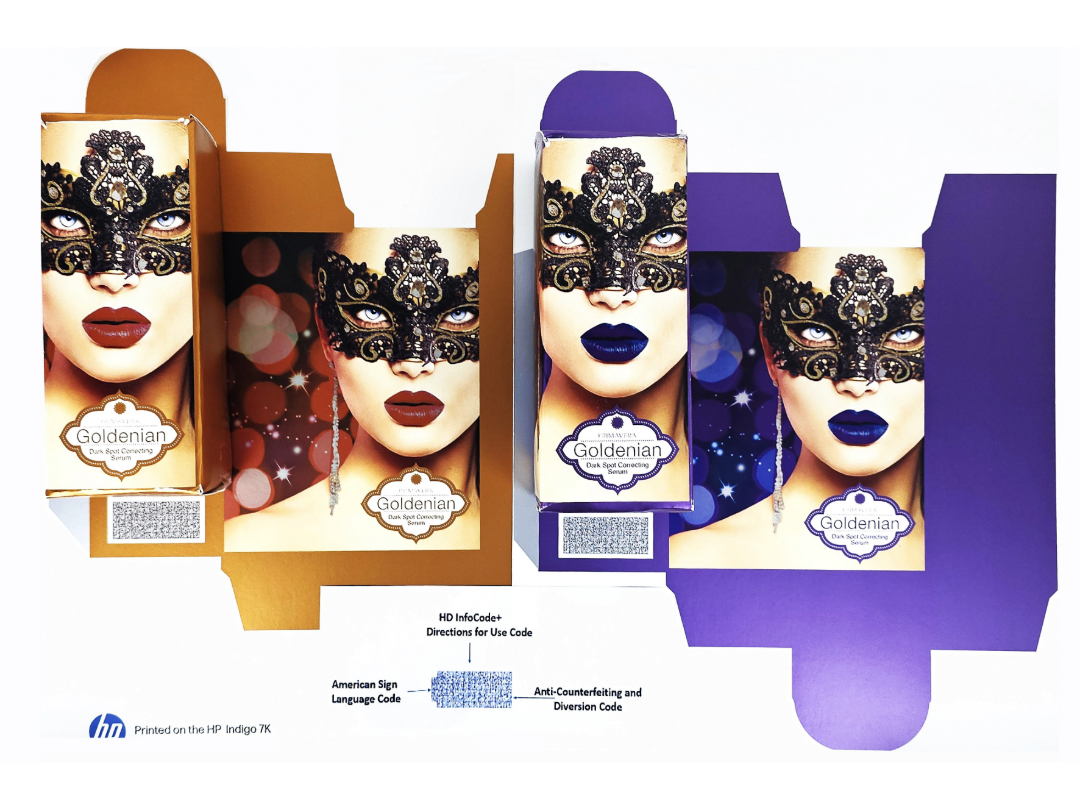
Parish emphasizes that a text comparison programme is capable of detecting missing or added content in the code, even when the digital and printed formats are not identical – ensuring that HD InfoCode matches the approved instructions and meets the FDA’s regulatory guidelines.
The code can also be embedded with anti-counterfeiting measures and a secure secondary message that only authorized smartphones can decode; this is hoped to strengthen supply chain integrity and combat counterfeit products without compromising accessibility.
A third code allows Deaf or hard-of-hearing users to scan their packaging at an in-store PC reader and unlock a video in American Sign Language (ASL), with Deaf Link indicating that American Sign Language is the third most used language in the U.S. and the common language of the Deaf community.
Reportedly, HD InfoCode can be created and verified in most languages for worldwide use. It is believed to embed 225 x more data in almost any language and can be shaped or printed to fit various packaging formats.
It also offers features like multi-language support, secure authentication, voice readouts, and even tactile markers like Braille or raised dots to locate the code.
HD Barcode urges food and pharmaceutical manufacturers, alongside the FDA, to adopt HD InfoCode as a recognized labelling standard.
Back in 2024, Roland DG revealed that 74% of visually impaired adults surveyed in the UK had picked up the wrong product whilst shopping due to inadequate packaging guidance. 31% of respondents expressed concern that they could not access key information about ingredients and allergens due to a lack of Braille or QR codes; in fact, 31% had picked up a product they couldn’t eat due to dietary requirements, and 23% had accidentally bought a product they were allergic to.
In response, Roland DG called upon brands to ensure inclusivity by introducing solutions like Braille or QR codes. Several have answered the call, including Strongbow; the company partnered with marketing agency Purple Goat to gauge the benefits of adding a NaviLens QR code to its packaging – a move hoped to help blind and partially sighted shoppers find and understand the product.
Conversely, Gary Parish warns that a single false QR code printed onto a pack could take a patient to a fraudulent site and introduce a “catastrophic risk”.
If you liked this story, you might also enjoy:
The ultimate guide to the Packaging and Packaging Waste Regulation in 2025
How are the top brands progressing on packaging sustainability?
Everything you need to know about global packaging sustainability regulation in 2025
The key to increasing the use of reusable packaging in supermarkets

PPWR is a data challenge. In this Spotlight, we find out how Centric Software® tackles the challenge through a connected

In this Spotlight, Plastipak discusses the opening of its PET material centre in Verbania, Italy. Home to pakPET™ Single Pellet

In the latest edition of the Spotlight, Matthew Wright, Founder and CEO of FOREST-PKG, shares why finding the right

Duynie has decades of experience in developing applications for side-stream potato starch. With Novinexx CPB, the company is applying


In this edition of The Spotlight, Markem-Imaje examines how 2D coding is redefining the role of flexible packaging and


The material that consumer and industrial (C&I) applications rely on just got a sustainability upgrade. DuPont talks us

Australian Vintage's Poco Vino offers wine in 178 ml single-serve bottles for easier transportation, lower-waste sampling,

UPM is working with Ingredion and Paramelt to research the use of starch-based barrier technologies for recyclable paper food

Z1RO has announced that industrial trials have been completed for its materials on automated wet moulded fibre equipment at Kiefel

Aliplast, part of Hera Group, has officially opened its R3GID (Recover Recycle Regenerate Plastic) recycling plant in Modena, Italy, capable