




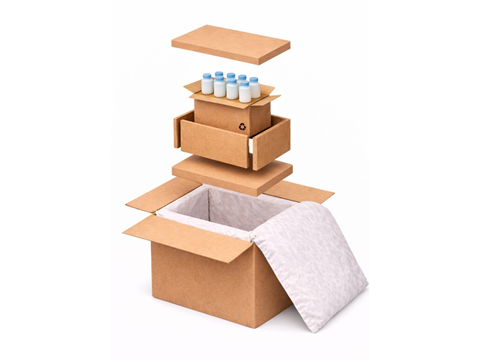
Ecocool has developed insulated packaging – including components made from recycled jute, cotton and starch – to ship temperature-sensitive medicines within a temperature range of 2°C to 25°C.
Developed as part of a client project, JuteBox Pharma is a shipping carton that contains an insulating liner made from jute – and builds on a previous iteration created for food products.
“The insulation fleece consists of recycled jute fibres bonded into a dimensionally stable liner using starch-based support fibres,” says Dr. Florian Siedenburg, managing director at EcoCool. “The liner is encased in a starch-based PLA film.”
According to Ecocool, jute provides ‘excellent’ thermal conductivity and moisture-regulating properties due to its ‘unique’ structure and inner hollow spaces. It is thought to match the thermal performance of expanded polystyrene boxes of the same thickness.
When used alongside phase-change material cooling elements, JuteBox Pharma can safely distribute temperature-sensitive medicines within a temperature range of 2°C to 25°C, and has been qualified to operate within this shipping range over a 72-hour period. It is reported to maintain the 2–8°C range for up to 48 hours.
This is expected to unlock an ‘all-season packout’ for sensitive pharmaceutical goods, meaning operators need not adjust their packaging processes based on the season.
“Jute fleece also offers good shock-absorbing properties,” Siedenburg continues. “This ensures mechanical protection against physical stresses encountered during transport.”
The outer wrap, which is said to account for less than 5% of the total weight, is made of cotton fleece. Its outer shipping carton is made from FSC-certified corrugated cardboard.
Reportedly, JuteBox Pharma’s insulation insert and wrapping film are both biodegradable in industrial composting facilities. The shipping carton is recyclable.
Ecocool says it has already secured its first pharmaceutical industry client for the 2°C to 25°C temperature range.
“With our jute-based packaging, we are now enabling more sustainable shipping within the pharmaceutical transport sector as well,” adds Dr. Siedenburg.
Customers can choose between standard or custom-made solutions featuring adjustments to size, temperature range, and coolant configuration.
In other news, DS Smith previously unveiled a fibre-based, temperature-controlled packaging solution for pharmaceutical and biotech businesses, intending to help customers store and transport delicate medicinal products while aligning with their sustainability targets.
Bouncee also created a collapsible crate for transporting food and pharmaceutical items – designed to balance high-quality temperature control with insulation cost reductions at scale. It is mainly designed for short-transit applications such as grocery e-commerce and pharmacy distribution.
Since then, Hydropac has updated its HydroFreeze range of water-based ice packs, with the new additions expected to help customers save energy, reduce waste, and use fewer packs for quicker conditioning operations.
If you liked this story, you might also enjoy:
The ultimate guide to packaging innovation in 2026
Packaging and Packaging Waste Regulation: what to know in 2026
Everything you need to know about global packaging sustainability regulation











No comments yet