




Credit: Amazon
Amazon is developing ‘extensible’ paper packaging with a water-soluble coating, said to double or triple the flexibility of standard kraft paper while maintaining recyclability.
Extensible paper is manufactured on specialized paper machines that ‘crepe’ the sheet while it is partially wet – reorienting the fibres inside the sheet to give it more stretch and absorb more energy before tearing. In a drop test, a 200-gram dart is said to bounce off Amazon’s extensible paper packaging.
Reportedly, the paper can stretch its dimensions by 5-7% before ripping. Unlike traditional kraft paper – described as ‘strong but stiff’ and said to take up space in delivery vehicles – the extensible paper is designed to mould neatly around a product without tearing at fold points.
Additionally, material scientists at Amazon have developed water-soluble coatings to help the extensible paper heat-seal like plastics without compromising fibre recovery in the recycling stage.
Another motivation behind developing extensible paper is to make Amazon’s packaging process ‘faster, easier, and more efficient’.
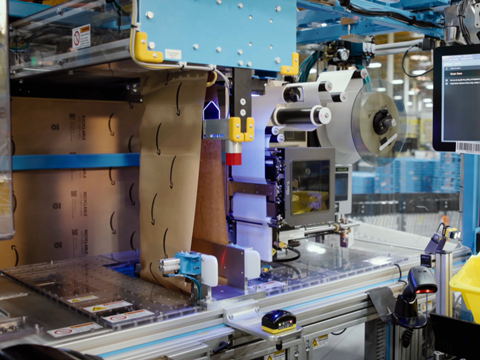
Whereas conventional kraft paper has not always proven to be compatible with Amazon’s automated packaging machines, extensible paper is considered fully suitable – helping streamline operations and reduce the burden on employees.
Amazon has retrofitted its existing plastic machinery to be fed with a large roll of extensible paper. The machine automatically sizes small products from a lineup of preset options, then seals, cuts and labels each item in a continuous process.
The extensible packaging is tested across two Amazon labs – one to test material science, the other to test the paper’s suitability for the fulfilment process.
A sheet former uses a slurry of water and fibre to create a sheet of paper, and a valley beater circulates paper fibres through a refining process. This is set to improve fibre properties in line with an industrial manufacturing process.
A freeness tester times how quickly water drains through the wood fibres to measure how much chemical and mechanical processing they have undergone – ensuring the rest results are both reliable and comparable.
Hydraulic pressure is used to measure burst strength by pushing air against the packaging until it ruptures. Prototype packages are dropped from different heights and angles to simulate short falls in the delivery process and test for any damage.
A vibration table shakes filled carts to reflect the vibration of carts, conveyor belts, trucks and planes, while climatic chambers and controlled rooms mimic hot and humid shipping conditions.
To simulate stacking, a compression tester applies top-load pressure. A forklift simulator squeezes packages from the sides, and a conveyor belt continuously loops sample packages.
Permeation analyzers are used to measure the moisture and oxygen resistance of the coatings, and an ink rub test attempts to smear the printing on the paper.
Currently, Amazon concedes that its extensible packaging ‘can’t handle everything just yet’ – magnetic products still stick to the machinery, oversized products cannot fit, and certain products require specialized labelling.
Yet the second testing lab is connected to a small fulfilment centre, which is said to process between 5,000 and 10,000 actual shipments daily.
Elsewhere in the industry, extensible paper is already used to package concrete, sugar, and other applications that require a material to stretch during filling.
It has also been used in Amazon’s European operations since 2021, and was first introduced to its North American networks last year.
If you liked this story, you might also enjoy:
The ultimate guide to packaging innovation in 2026
Packaging and Packaging Waste Regulation: what to know in 2026
Everything you need to know about global packaging sustainability regulation















No comments yet