


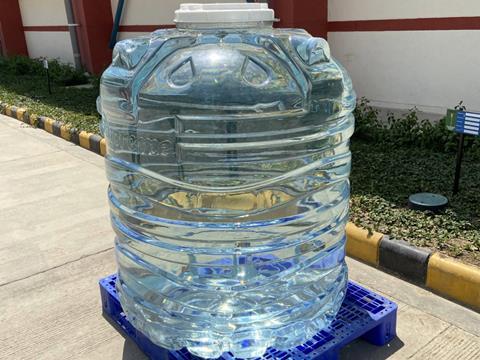
CYPET Technologies claims to have created the ’world’s first’ 1000 litre PET water tank, nominated in the Circular Plastics category of the Sustainability Awards and said to be around 40% lighter than traditional HDPE 1000 litre tanks. We spoke with CYPET project manager Giorgos Mouskis to find out more about this entry.
You’re a finalist in the Sustainability Awards 2026. Congratulations! To start off, could you summarize your entry in less than 50 words?
Our entry is the world’s first 1000 litre PET plastic water tank, made on a single-stage injection stretch blow moulding machine developed by CYPET Technologies. The tank is the largest PET bottle in the world and weighs close to 10kg, around 40% lighter than traditional HDPE 1000 litre water tanks.
Why do you think the judges were impressed with your entry? Tell us what is innovative about your project’s impact on packaging sustainability.
The sheer size of the PET water tank definitely makes an impression (wait until you see the size of the machine that makes it!), because when people hear ‘PET bottle’ they think about 1 litre water bottles, not something 1000 times bigger. The innovation is not only the design and engineering of the PET water tank itself, but also the creation of the machine and process that makes this tank. There is no other machine in the world that can make such a large PET container.
There are two sustainability impacts from this innovation. Firstly, the lower weight of the water tank means you save 6-8kg of plastic per tank produced. The reduction in raw material used to make this product is huge, saving tonnes of raw material (and equivalent energy to transform it into a water tank) per year. There are also CO2 savings in transporting these large pieces from production factory to the end customers. PET is also 100% recyclable, supporting a circular economy and reducing plastic waste.
In addition, typical PET bottles are made by melting plastic raw material, injecting a tube (called ‘preform’), cooling that down to room temperature before re-heating it up to 100C in a separate machine and blowing it into the final bottle. On a CYPET machine, the injection moulding of the preform and blowing into a water tank is all done within the same machine. This saves space but more importantly saves a large amount of energy. Since the preform is immediately blown into a bottle within the same machine, it doesn’t need to be cooled down to room temperature. It is partially cooled to the blowing temperature without any need for re-heating, reducing the process’ energy consumption by a further 25%.
Finally, can you tell us about the ongoing development of your project – for example, what are the next steps in commercialization and product development?
The innovation has taken the industry by surprise (pretty much no one thought that such a large PET container could be made) and has opened up a new frontier for PET to serve as packaging for new applications. Next steps would be to validate the product in real life environments and then introduce it into the market.
This specific water tank is produced by one of our customers for the Indian market. Many other customers are requesting samples to validate in their own respective markets. It will be exciting to see its worldwide adoption.
The winners of this year’s Sustainability Awards are due to be announced on the 11th November at the Sustainable Packaging Summit, taking place from the 10th-12th November in Utrecht, Netherlands. The Summit mobilizes leaders of the FMCG value chain, policymakers, NGOs, recyclers and investors to collaborate, remove barriers and identify opportunities on the road to sustainable transformation.
To learn more or register, visit: https://www.packagingsummit.earth
If you liked this story, you might also enjoy:
The ultimate guide to packaging innovation in 2026
Packaging and Packaging Waste Regulation: what to know in 2026
Everything you need to know about global packaging sustainability regulation











No comments yet