
“Industry-first” common protocol for evaluating film packaging recyclability in Japan
The artience Group, through its packaging solutions subsidiary Toyo Ink Co., Ltd., and DIC Corporation has announced the development of
The artience Group, through its packaging solutions subsidiary Toyo Ink Co., Ltd., and DIC Corporation has announced the development of

The operational impacts of PPWR and how it shapes packaging decisions across the product lifecycle.
ACG Packaging Materials has released RecycloPod PP Ultra, a polypropylene-based blister packaging system that offers recyclability and barrier protection

Evonik’s acrylate-based co-binder for solvent borne packaging inks is designed to improve recyclability and remove ink within minutes. A finalist in the Circular Plastics category of the Sustainability Awards, we spoke with the company to find out more.
You’re a finalist in the Sustainability Awards 2026. Congratulations! To start off, could you summarize your entry in less than 50 words?
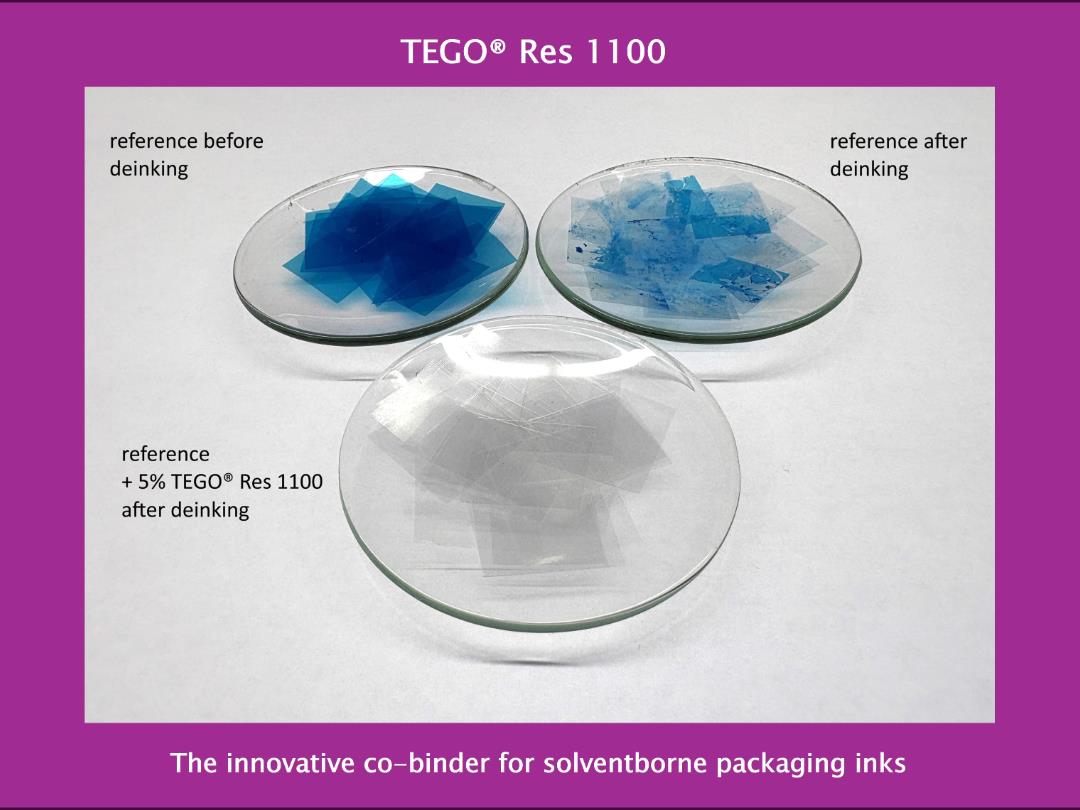
TEGO Res 1100 is an acrylate-based co-binder for solvent borne packaging inks that enables rapid de-inking in caustic soda. It removes ink within minutes while maintaining print quality and replacing 3–5% of conventional binders. Food-contact compliant and easy to use, it improves recyclability without altering ink performance or processing.
Why do you think the judges were impressed with your entry? Tell us about what is innovative about your project.
The judges were likely impressed by TEGO Res 1100 because it delivers a highly innovative and practical solution to one of the key challenges in plastic packaging recycling: efficient de-inking. Unlike conventional inks, which often require high temperatures and long processing times for complete ink removal, TEGO Res 1100 enables rapid and complete de-inking at temperatures as low as 30°C. This significantly reduces energy consumption while producing cleaner recyclates suitable for high-quality applications.
A key innovation is that TEGO Res 1100 is formulated directly into the printing ink rather than being applied as a separate primer layer. This eliminates the need for changes to packaging structures or additional printing stations, making it an easy-to-adopt, cost effective solution for converters and ink manufacturers. What is quite remarkable is that the technology improves the recycling process itself.
Inks containing TEGO Res 1100 can be removed using only caustic soda, without the need for specialized surfactants. The detached ink forms larger particles that are easier to separate from the washing solution and significantly reduce the risk of staining the recycled material. Most importantly, the sustainability impact is substantial.
A life cycle assessment conducted according to ISO 14040/44 showed that greenhouse gas emissions can be reduced by up to 75% when the fully de-inked recyclate is able to replace large amounts of virgin material. By enabling higher quality recycling with lower energy use, TEGO Res 1100 makes packaging recycling more efficient, economical, and climate friendly than existing solutions.
Finally, can you tell us about the ongoing development of your project, such as how your innovation has been received by the industry and what the next steps are in product development?
Since its launch, TEGO Res 1100 has received very positive feedback across the packaging value chain. The product has already been tested at industrial scale by ink manufacturers and converters, with results confirming that it can be integrated into existing production processes without negatively affecting standard operating parameters or print performance.
The next phase of development focuses on demonstrating the benefits of the technology during recycling. We are actively involved in consortium projects to validate large scale de-inking performance and to prove the high mechanical and optical quality of the recycled material produced from de-inked packaging waste.
In parallel, we are engaging with Producer Responsibility Organizations (PROs) to explore how de-inkable printing inks could be recognized within Extended Producer Responsibility (EPR) fee modulation schemes, creating additional incentives for adopting more recyclable packaging solutions. On the product development side, we are expanding the technology platform beyond solventborne inks.
We have already developed an advanced development product for UV-curable inks, which is currently undergoing customer testing. These developments will help extend the benefits of improved de-inkability and high-quality recycling to an even broader range of packaging applications.
The winners of this year’s Sustainability Awards are due to be announced on the 11th November at the Sustainable Packaging Summit, taking place from the 10th-12th November in Utrecht, Netherlands. The Summit mobilizes leaders of the FMCG value chain, policymakers, NGOs, recyclers and investors to collaborate, remove barriers and identify opportunities on the road to sustainable transformation.
To learn more or register, visit: https://www.packagingsummit.earth
If you liked this story, you might also enjoy:
The ultimate guide to packaging innovation in 2026
Packaging and Packaging Waste Regulation: what to know in 2026
Everything you need to know about global packaging sustainability regulation


In this edition of The Spotlight, Markem-Imaje examines how 2D coding is redefining the role of flexible packaging and


The material that consumer and industrial (C&I) applications rely on just got a sustainability upgrade. DuPont talks us


Utilizing vacuum aluminizing and laser-writing technologies, Shunho Creative (a sub-brand of Shanghai Shunho International) has developed a plastic-

Seeking to meet the challenges of the climate crisis and regulatory changes, Smurfit Westrock is investing in its manufacturing network,

ATS-Tanner’s banding solutions aim to reduce packaging waste, provide a practical alternative to plastic and improve recyclability. In

The artience Group, through its packaging solutions subsidiary Toyo Ink Co., Ltd., and DIC Corporation has announced the development of

ACG Packaging Materials has released RecycloPod PP Ultra, a polypropylene-based blister packaging system that offers recyclability and barrier protection

Borouge International has invested in mechanical recycling capacity at multiple plastic recycling facilities, aiming to boost its annual output by

Bringing sustainability-minded ideas to market requires us to think outside the box and address familiar challenges from a different