

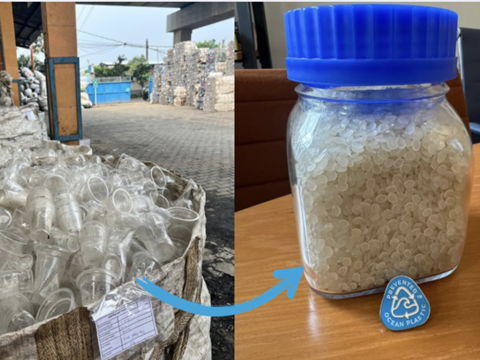
Prevented Ocean Plastic is a finalist in this year’s Sustainability Awards with its project seeking to recycle polypropylene (PP) to the European food-safe standard. Nominated in the Circular Plastics category, we asked the company a few questions to find out more.
You’re a finalist in the Sustainability Awards 2026. Congratulations! To start off, could you summarize your entry in less than 50 words?
Prevented Ocean Plastic have combined controlled waste plastic collection, advanced mechanical recycling and technological innovation to recycle polypropylene (one of the most used but least recycled plastics on the planet) to the European food-safe standard - a world first.
Why do you think the judges were impressed with your entry? Tell us about what is innovative about your project and its impact on packaging sustainability.
This project is a true innovation. Polypropylene is widely used but has a global post-consumer recycling rate of only around 1%, partly because inconsistent feedstock and contamination have made high-quality, food-safe recycling extremely difficult. Prevented Ocean Plastic prioritized long-term collaboration over short-term gain and brought together partners across the entire supply chain to overcome those barriers.
Controlled collection and sorting, feedstock customization, advanced mechanical recycling and scientifically validated decontamination has enabled our recycled PP to meet EU 2022/1616 food-contact requirements. The impact goes beyond producing a new material. By creating a high-value application for discarded PP, we can make its collection more economically viable in coastal communities where it is most at risk of reaching waterways and our oceans.
The first-year capacity is expected to be equivalent to around 500 million single-use PP cups, while also opening the door to greater recycled content in packaging formats that have historically been difficult to circularize.
Finally, can you tell us about the ongoing development of your project, such as how it has been received by the industry and what the next steps are in commercialization?
Since launch, the focus has been on moving from technical breakthrough to commercial adoption. The material is already in use across different packaging applications.
Innovia Films is using it to develop BOPP films for food and beverage packaging, while Spectra Packaging is exploring bottles and caps through blow moulding and injection moulding, alongside further potential applications such as food trays. Innovia has described access to mechanically recycled, EU food-contact-approved PP as a “game changer”.
The next stage involves scaling both supply and demand - increasing production capacity, bringing more packaging applications and offtakers into the system, and expanding the collection infrastructure that provides the feedstock. This rPP innovation, led by a UK business operating globally, is a world-first, and this same approach to collection and sortation can be aimed at virtually every discarded plastic type on the planet.
The winners of this year’s Sustainability Awards are due to be announced on the 11th November at the Sustainable Packaging Summit, taking place from the 10th-12th November in Utrecht, Netherlands. The Summit mobilizes leaders of the FMCG value chain, policymakers, NGOs, recyclers and investors to collaborate, remove barriers and identify opportunities on the road to sustainable transformation.
To learn more or register, visit: https://www.packagingsummit.earth
If you liked this story, you might also enjoy:
The ultimate guide to packaging innovation in 2026
Packaging and Packaging Waste Regulation: what to know in 2026
Everything you need to know about global packaging sustainability regulation











No comments yet