




Recent trials by NEXTLOOPP, Süper Film and Brückner Maschinenbau have reportedly demonstrated for the first time that food-grade recycled polypropylene can be processed into biaxially oriented polypropylene (BOPP) film under standard commercial production conditions. Professor Edward Kosior, the founder of the NEXTLOOPP project and a previous Packaging Europe Sustainability Awards winner, tells us more about this landmark news.
For years biaxially oriented polypropylene (BOPP) has ranked as one of the toughest materials to address in the circular packaging conversation. It is also one of the most widely used flexible film formats in food packaging, prized for its clarity, barrier performance, printability and mechanical strength.
Flexible PP packaging has, until now, had no closed loop back into food-grade film at all — unlike PET bottles or HDPE milk bottles, which have established food-grade recycling routes. BOPP is a particularly hard case even within that picture: its highly demanding, high-temperature stretching process has made it notoriously resistant to recycling, held back by a combination of process sensitivity and a shortage of clean and consistent recycled polypropylene (rPP) feedstock.
This is now changing. Recent trials carried out by NEXTLOOPP, in collaboration with Süper Film and Brückner Maschinenbau, have demonstrated for the first time that food-grade rPP can be processed into BOPP film under standard commercial production conditions — with no film breaks, no process disruption, and no significant re-optimisation of line settings.
This is a result with real implications for how the industry approaches the EU’s Packaging and Packaging Waste Regulation (PPWR), which sets binding recycled-content targets that BOPP producers have so far struggled to meet.
From the lab to the pilot line
The project followed a disciplined, staged approach — precisely the kind of methodical validation that gives this result its credibility. NEXTLOOPP supplied rPP from their NEXTLOOPP Americas’ participant, Alcamare, a recycler based in Mexico. This rPP was sourced from a tightly controlled, single-source stream of PP food packaging with a low melt index. The material was hand-sorted, then verified using near-infrared (NIR) and optical sorting systems, with a final colour check to screen out contaminants. This kind of feedstock discipline matters enormously for BOPP, where process tolerances are unforgiving. This was followed by washing, extrusion and decontamination steps as specified by the USFDA LNO process technology with applicability with all food types and conditions of use from A to H.
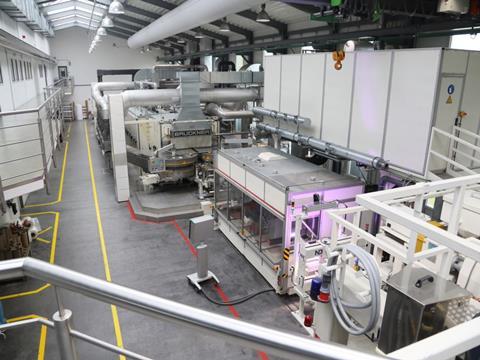
Brückner Maschinenbau first put the material through its paces in the laboratory: chemical analysis, extrusion trials on a laboratory extruder, and biaxial stretching tests on a KARO laboratory stretcher, across a range of rPP concentrations. The material analysis showed the rPP to be a PP copolymer with a profile broadly comparable to virgin BOPP-grade PP in terms of melt flow rate, and within an acceptable range for thermo-oxidative stability. These early results were promising enough to justify the next, much bigger step: production trials on Brückner’s BAL pilot line, run under conditions that mirror a real commercial BOPP process.
What the pilot line proved
This is where the headline result was established. Working to a standard five-layer coextruded film structure of around 25 microns — the kind of construction used across flexible food packaging — the team incorporated rPP into the core layer and ramped up the recycled content step by step, starting at a total film content of 20%.
At this level, the stretchability of the material could be generally proved using standard process parameters, with only minor adjustment to equipment settings. That is the detail that matters most for converters: this was not a bespoke, hand-nursed trial run, but a demonstration that the material can be handled the way a production line handles material every day. The line ran without a single film break throughout the trials — a strong practical indicator of process robustness given how unforgiving sequential biaxial orientation normally is.
Just as importantly, the film’s mechanical and optical properties at 20% recycled content met the technical standards required for coextruded BOPP packaging film. Tensile strength was around 10% lower than the 100%-virgin reference roll but remained within the requirements for this film type and gloss transmittance and clarity showed only a slight decline.
Clean feedstock confirmed in the data
One of the more reassuring findings to come out of the trial concerned particulate residues in the recycled material. Melt filter pressure — a sensitive early-warning indicator of feedstock residues in extrusion processing — remained stable throughout the periods when rPP content was held constant, with pressure increases only appearing at the points where the recycled content was deliberately stepped up. That pattern is exactly what you would expect from a well-controlled, low-contamination feedstock, and it validates the rigour of Alcamare’s single-source sorting process. For an industry that has been repeatedly challenged by inconsistent recyclate quality, this is a meaningful data point: it shows that sourcing discipline upstream translates directly into processing stability downstream.
Why this matters for PPWR
The timing could hardly be more relevant. PPWR sets binding minimum recycled-content thresholds for plastic packaging, and food-contact flexible packaging — much of it BOPP-based — that has been one of the hardest categories for which the industry to map a compliance pathway. Until now, brand owners and converters relying on BOPP have had very little hard evidence that recycled content could be incorporated without a costly re-engineering of their production lines or a compromise on shelf performance.
This trial changes that picture. A 20% total recycled content level, achieved on a real pilot production line using commercially available food-grade rPP and standard process settings, except for the line speed, is precisely the kind of evidence base that gives converters, brand owners and packaging technologists something concrete to plan around. It moves BOPP from “a format we don’t yet know how to recycle back into high-quality resin” to “a format with a demonstrated, working route to PPWR-relevant recycled content.”
It is also a strong signal to the wider recycling and reprocessing sector about the value of well-sorted, single-source feedstock. The Alcamare food-grade rPP material’s performance in this trial underlines that the specification of the feedstock, the quality of sorting and decontamination steps provide the basis for the verification upstream that unlocks usability in demanding downstream applications like BOPP — a message that should encourage further investment in high-quality food-grade PP recycling infrastructure.
What comes next
The NEXTLOOPP consortium’s next step is to take this work from the pilot line to an actual production line at typical BOPP-production speed at Süper Film, building on the 20% recycled-content formulation validated here as the initial commercial target and working towards higher percentages. Work will also continue on refining the process further, giving the industry a clearer picture of how the pathway can be optimised over time as rPP quality and availability improve.
For a film format that has long been considered one of the toughest challenges for recycled content, this is a genuinely significant milestone. It shows that with the right feedstock discipline and the right process partners, food-grade rPP and commercial BOPP production are not mutually exclusive. That is good news for converters facing PPWR deadlines, for brand owners looking for credible sustainability claims on flexible food packaging and for a recycling supply chain that now has concrete proof that its output can meet one of packaging’s most demanding processing challenges.
If you liked this story, you might also enjoy:
The ultimate guide to global packaging sustainability regulation in 2026
PPWR timeline: the key dates to know















No comments yet